Wednesday, July 25

Revisiting Ireland

We’ve been back from Ireland for over a week now, catching up on the mundane of existing in Okemos. Things like paying bills, organizing photo, volunteer commitments, getting the lizard to like us again, etc.…..

Where to start with Ireland? This is one of those trips that it takes a while to process. It’s something you have to mull over, like a glass of Jamison’s Black Barrel whiskey. Something to savor, not to chug like a cretin frat boy.

This was a very different trip for me, one that I’m not entirely comfortable writing about. Both Lise and I have some genetic ties to Ireland. Most of the U.S. population probably has some tie to Ireland. At least if they’re lucky.

I am not much into the ethereal spiritual kind of stuff. I really am a “I am what I am, and you get what you see” kind of person. But there were places in Ireland where I thought, “OK, this is weird, I’ve been here before.” This isn’t because I had seen pictures in a travelogue somewhere. This was driving along and saying, “I going to walk to the top of that hill because I know that hill. I’ve been there before”. This was a little spooky but at least I didn’t walk up there barefooted.

When you start analyzing a place, its history of a place is always a good place to start. In Ireland, you can’t swing a dead cat around without hitting something historic. It might be 5,000 years old historic, it might be 100 years old historic. You’re driving along and there’s the ruins of a 3,000 year old stone ring fort in someone’s back yard. Or a music school from the 1400s and two blocks away a pub from the 1600s. Or the remains of stone cottages abandoned since 1840’s famine. Or a marker from the 1916 Easter Rising. You can’t look at the Book of Kells, or walk through St. Stephan’s Green, without being moved.

A good part of Irish history is tragic at best. Christianity may or may not have been a good thing for the Irish. The British were very decidedly a bad thing. You learn to not like the British early on in a trip to Ireland. The British have screwed up pretty much every part of the world they’ve come in contact with, but it seems they put extra effort into screwing Ireland.

Interwoven with Irish history is spirituality and culture. They can’t be separated. We spent two nights at Hopewell Retreat, site of a spring used for a couple thousand years. We met the owner, your basic Irish farmer in rubber boots and smelling like manure. He is convinced there is something spiritual about the water and built a place worthy of it. He could have just set up a wooden shack, or just pumped water out of the spring. Instead he built something fitting the spirituality of the place. As he said, “something the old ones could appreciate.” That Irish farmer with dung on his boots was also more literate about the American political system than most Americans are.

Pubs are an integral part of Irish culture that I rather enjoyed. Pubs are an Irish way of life. Not the tourist pubs of Dublin’s Temple Bar district, where tourists go to get drunk. Every neighborhood or village has at least one pub, usually more. Places you can walk to and be welcomed in, even as a stranger. Irish pubs are very different from American bars. These are meeting places where the whole family comes. You don’t drink until the wee hours of the morning, just to get blitzed. You come for a pint, and maybe grab a bite to eat. Maybe watch a hurling or Gaelic football game on the tube. Most pubs close around 10:00 or 11:00.

The Irish also do whiskey in a good way. They didn’t invent distillation. That goes way back, probably to Mesopotamia. Good arguments can be made for the Irish inventing whiskey, though the Scots seem to think they have a lock on it. Either way, whiskey has Celtic origins.  The English word for whiskey is derived from the Gaelic word Usque baugh, meaning water of life.

As usual with the Irish things seem to go boom and bust. Whiskey distillation was going fine, then the British put tax and tariff penalties on Irish whiskey to prevent competition with English and Scotch whiskey. This effectively locked the Irish out of the British and European markets. Some legal Irish whiskey making still persevered, marketed primarily to the U.S. Then along came the American prohibition. With all their eggs in one basket, most legal Irish distilleries went out of business. There was something like 30 plus distilleries pre-Prohibition, and only three survived Prohibition. They’re coming back though, and in fine form too. My favorites are Tullamore DEW or Jameson Black Barrel. Either is a fine sip that I’m more than happy to have in my cup.

Everyone, everywhere, was friendly. Whether in metropolitan Dublin, or out in some fishing village, everyone was nice. I’m sure there are bad people in Ireland. There are jackasses everywhere. But we didn’t meet any during our trip. Well maybe a few tourists, probably French. Everyone was nice and friendly. Even when I blocked traffic by stalling the car in the middle of some god-forsaken traffic roundabout, at worst I would get a little toot from a horn.

For me, the friendliness was epitomized in a pub right before we left. It was a little place, close to where we were staying. Came time to pay and they didn’t have a charge card system set up. We didn’t think we had enough Euros so the bartended just said, “Don’t worry about it. If you’re coming back tomorrow you can just pay me then.” He said this to two total strangers he knew didn’t live thereabouts. Where in the States is something like that going to happen?

To describe Ireland, I think of the Jill and Leon Uris book, “Ireland, a Terrible Beauty”. Ireland is a sublimely beautiful place, where every stone has seen its share of history. A place that takes friendliness to an extreme, where everyone is welcome It is also a tragic place, where many of the tragedies can be laid at the feet of the British. Whether entire villages massacred by Cromwell or preventable famines, the Brits have systematically tried their best to destroy Ireland and Irish culture. The Church hasn’t helped much either.

Ireland is a hard place to make a living. Given it’s tragic past, it’s easy to see why, for hundreds of years, Ireland’s chief export has been people. Whether it was the Flight of the Wild Geese, Irish men going to continental Europe as mercenaries, or Irish penal ships populating Australia, or modern immigrants leaving for economic reasons. But Ireland is also a place of history, beauty and spirituality. As hard as it is to live there, some have always stayed and continue to stay. I raise a toast to them. And I will be back there. If not in body, in spirit.

Wednesday, July 18, 2018

We are now back from Ireland, shaking off jet lag, and letting the significance of everything settle in. The following itinerary will give some idea of why I never posted during the trip. In a couple days we should have our life back in order and I can write something more meaningful than an itinerary.

Thursday, July 5
Arrived at 5:30 AM Dublin time. Picked up the rental car and was immediately thrust into Dublin rush hour traffic. Driving on the opposite side of the road and using my left hand to shift a six-speed transmission. The GPS was giving road names in Gaelic. Got to the first of thousands of roundabouts. Apparently, the Irish use roundabouts to ensure that no invading army will ever get to its destination. While the Irish sit in a pub with a pint watching the show. Lise heard words coming out of my mouth that she never heard before. Finally got to the Airbnb where we were staying and crashed for a couple hours. Got up, toured the Guinness brewery, walked around Temple bar, met Lindsay for dinner, then crashed again for the night.
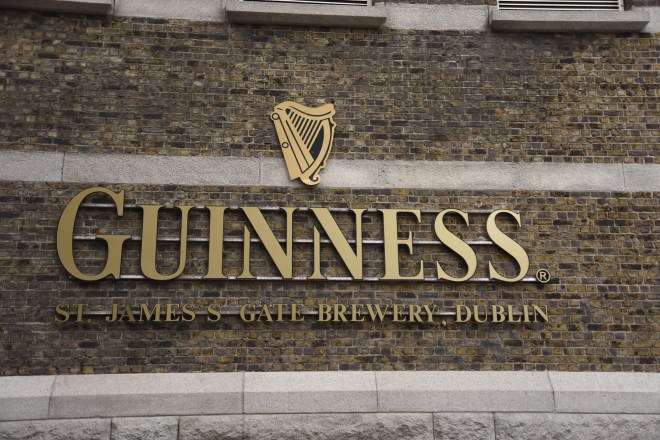
_DSC0389Guinness.

IMG_1212Having a pint in the Guinness storehouse.
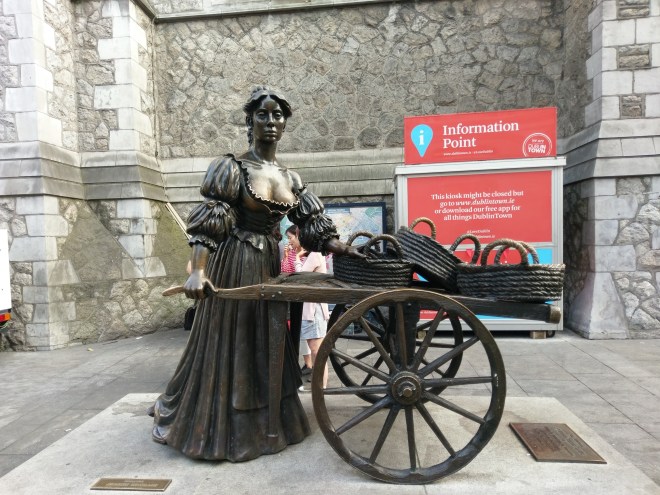
IMAG0035Molly Malone of the song. Our Molly’s namesake. We were discussing names when the song came on the radio and that was all she wrote.

Friday, July 6
In the morning we met up with Lindsay and headed to the historic Boyne Valley. Switched from driving in Dublin to Irish country roads. About the only difference is the higher speed limits in the rural roundabouts. Circular death.

_DSC0590This road is two way traffic, 80 kilometer/hour speed limit. That’s 48 MPH.

We started at Kells to see the Celtic crosses. By now a dose of religion may have been a good thing for me. After Kells we hit Loughcrew Cairns, a prehistoric passage tomb, older than Stonehenge and the Great Pyramids. We also went to Trim to see Trim Castle, used as York Castle in the movie Braveheart.

Kells Celtic crosses.

The 5,000 year old Loughcrew Cairns passage tomb.

_DSC0425

_DSC0429

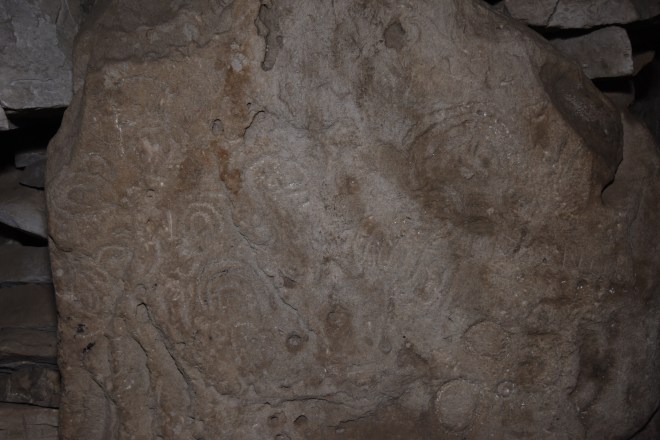
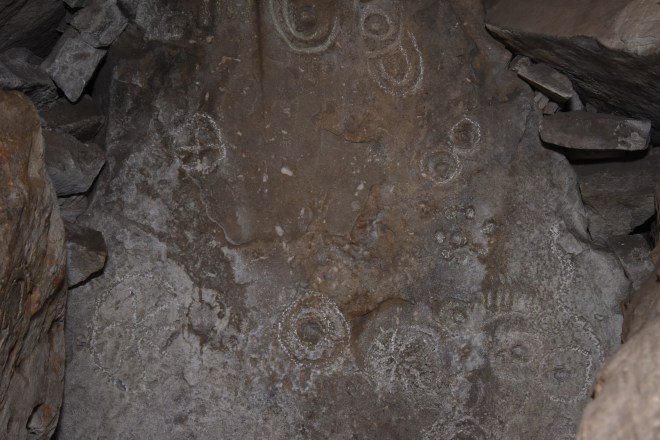
_DSC0431Some of the 5,000 year old symbols inside the tomb. Meaning unknown.

Trim castle.

Friday night we stayed at Hopewell retreat, site of a spring that has been used as a water source for a few thousand years. The spring is on a private farm. We stayed in what was once the stables converted to an apartment. More on Hopewell Retreat in a later post.

Hopewell retreat.

Saturday, July 7
We started Saturday going back to Trim Castle where we promptly got a parking ticket.

After Trim we went to Hill of Tara, the traditional seat of the Irish high kings. Tara has a large rock phallic symbol at the top of the hill. A newly crowned king had to drive a chariot around with his wheels touching the rock. Ancient legends had a godlike people, the Tuatha Dé Danann, bring the stone to Tara as a sacred object. The stone will roar when touched by the true King of Ireland. Not a murmur when I touched it. Or the group of German witches that were seeking some kind of spiritual thing.

The Lia Fail or Stone of Destiny. Bottom right is a group of German women that were have a seance and rubbing the stone. It was weird.

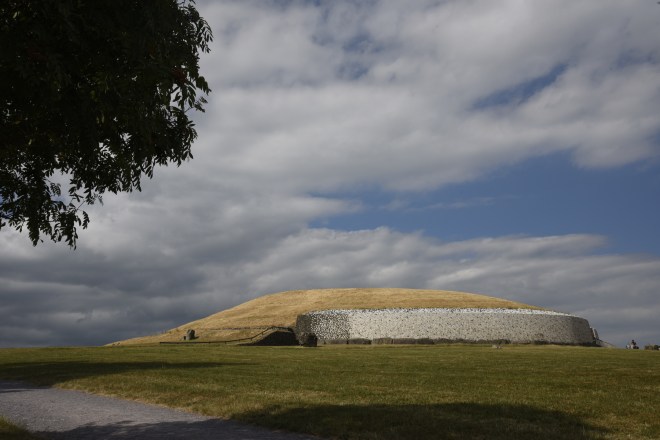
After Tara it was Newgrange, like Loughcrew Cairns another prehistoric passage tomb. Much better preserved than Loughcrew though. Both Loughcrew Cairns and Newgrange are older than Stonehenge and the Giza Pyramids by something like a thousand years. These aren’t just piles of rocks stacked up. They were planned, built, and decorated with a purpose now lost to us. On the winter solstice the sun shines the length of the passages to light the center.
_DSC0498

Newgrange passage tomb. Around 5,000 years old.
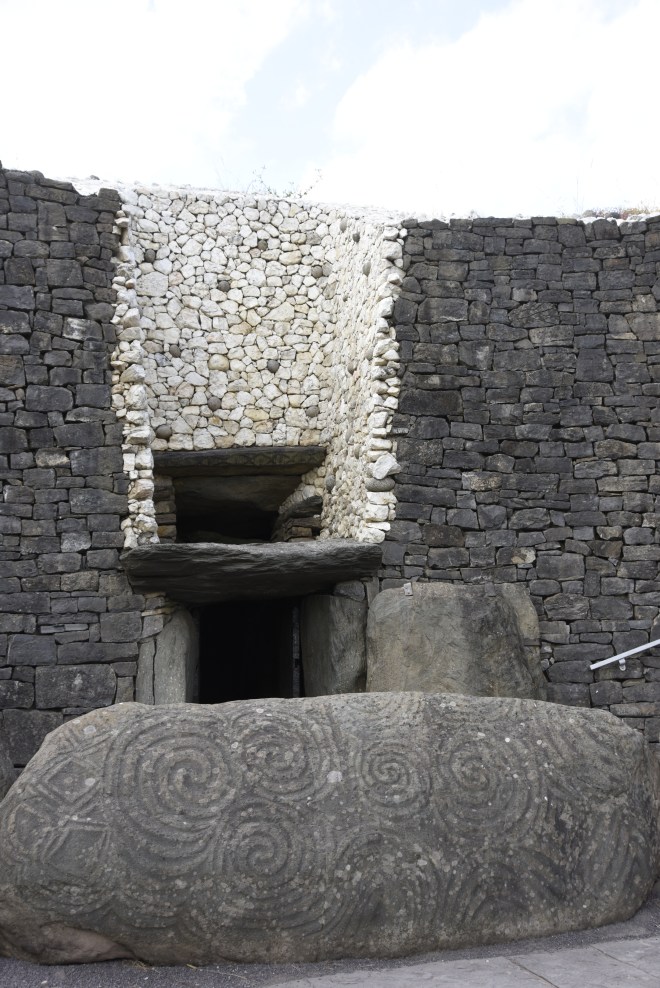
_DSC0503The entrance to the tomb. The large rock is what prevented the site from being destroyed. In 1699 a quarry was started but the first thing they hit was this entry rock. The locals doing the quarrying realized this was significant leading to the eventual preservation of one of the most complete neolithic sites known. On the solstice the sun shines through the top opening illuminating the interior passage and central area.

Newgrange.

After Newgrange it was back to Hopewell for another night among the spirits with no internet connectivity.

Sunday July 8.
Sunday, we did a bit more driving around the Boyne Valley and visited the ruins of Mellifont Abby. Mellifont was in use from 1142 until 1539. William of Orange used it as a headquarters during the battle of the Boyne in 1690.

The ruins of Mellifont Abby.

After Mellifont we drove back to Dublin Town to drop off Lindsay. She tried to navigate us through Dublin and its traffic to her housing at University College Dublin. All survived my Dublin driving, but we left her in a state of shock a few minutes from where she lives. Surprisingly she is still talking to me.

Monday, July 9
Lise and I headed from Dublin to the Irish west coast to spend four days in what is billed as, The Wild Atlantic Way. And wild it is. In addition to the hazards of Irish driving I became accustomed to, let’s thrown in huge tour buses. And maybe crank up the speed limit a bit.

_DSC0660Two way traffic, 100 kilometer/hour speed limit. That’s 62 MPH. Cliff on one side, ocean on the other.

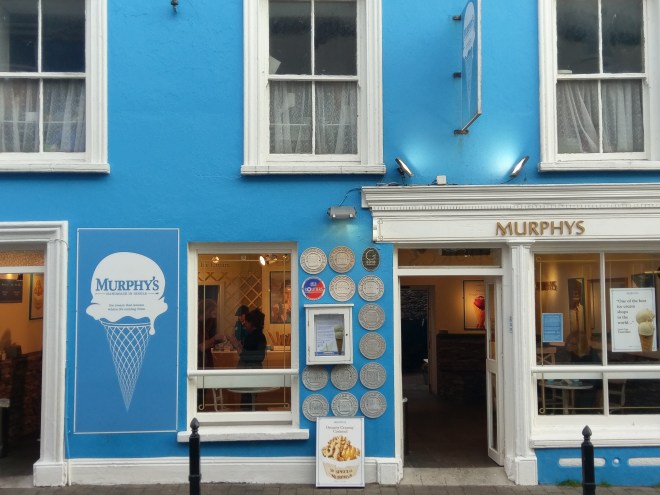
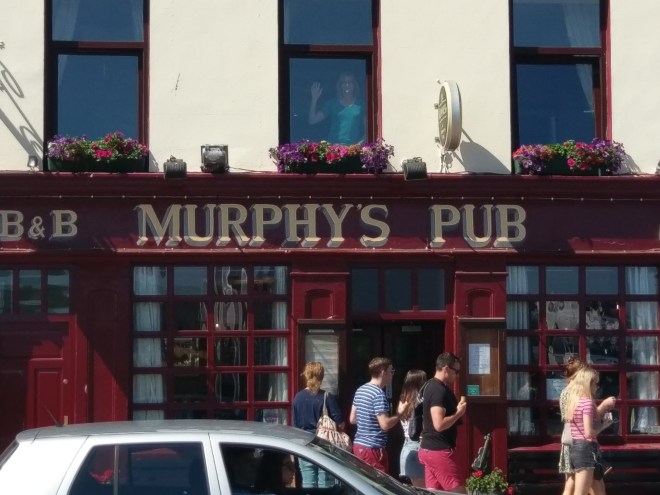
We spent our first night in Dingle, a small fishing village that also serves tourists as the jumping off point to the Slea Head drive. We stayed in rooms over Murphy’s Pub. There was also Murphy’s Ice Cream and Murphy’s Stout. Dingle isn’t very large so I’m really hoping we aren’t getting into a cousins marrying kind of thing.
IMAG0037

Lise in the window of Murphy’s pub.

IMAG0041Murphy’s Ice Cream. Right up the street from Murphy’s Pub and considered some of the best ice cream in Ireland.

IMAG0043Murphy’s Stout, served at Murphy’s Pub.
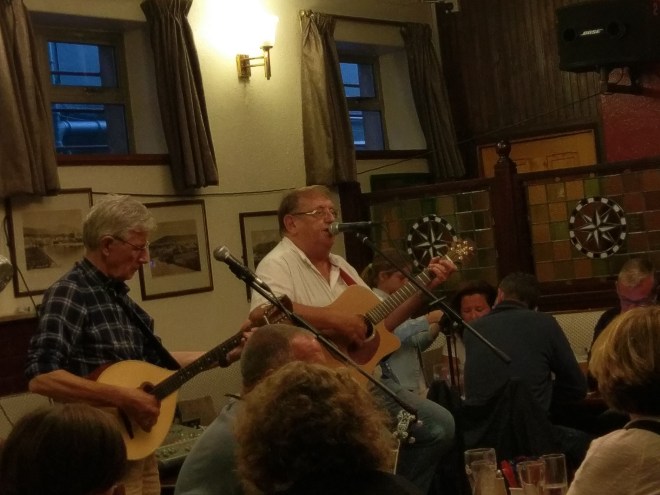
IMAG0045Musicians in Murphy’s Pub.

_DSC0608The Temperance Hall in Dingle which, from what I’ve observed, is not used very much.

_DSC0599View of the Irish countryside on the way to Dingle.
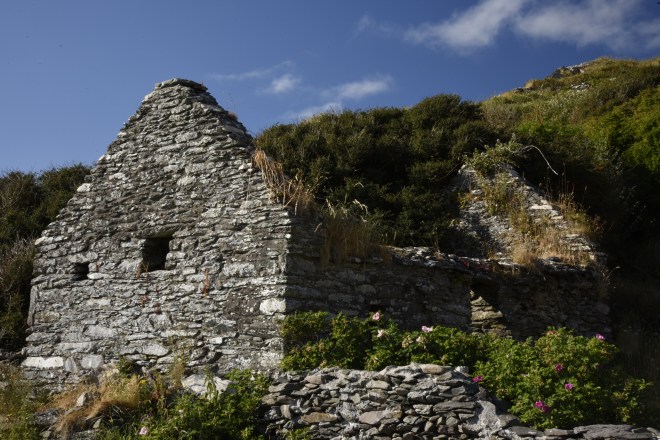
_DSC0640An old cottage on the Slea Head drive.

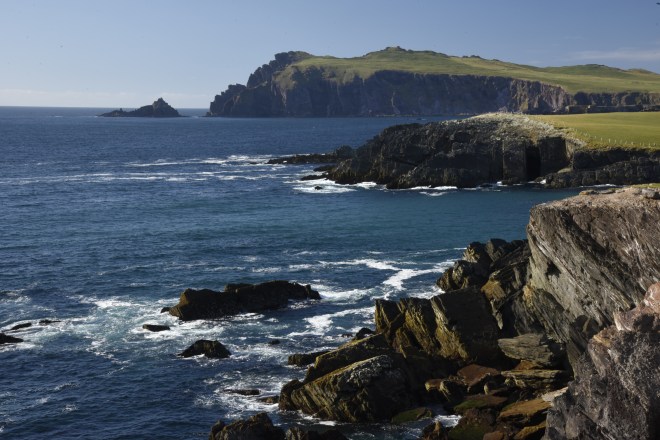
_DSC0653Slea head, where the film Ryan’s Daughter was filmed.
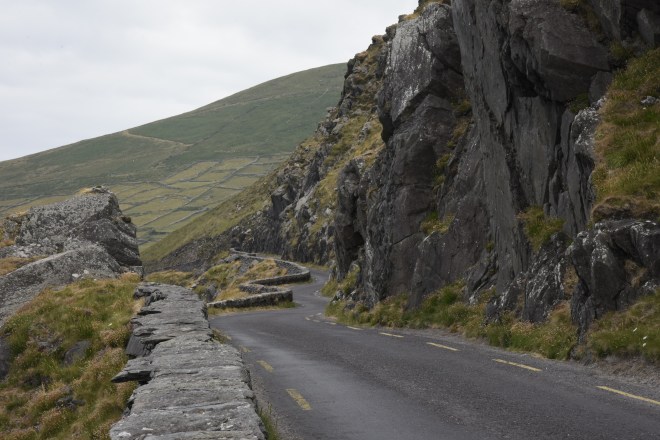
_DSC0661The road around Slea Head.

_DSC0669Lise on the beach.

Tuesday, July 10
We spent Tuesday morning driving around Slea Head and doing some hiking, then headed down to Valentia Island. Doing parts of the famous Ring of Kerry along the way.

Views from hiking around Slea Head.

On Valentia Island we stayed in Knightstown, another small fishing village. Our accommodations were at the Royal Valentia Hotel, a hotel since that 1880s. The Royal Valentia was kind of the center of town life, a primary eating, drinking, and meeting place, with a seafood chowder to die for. Kind of like Murphy’s in Dingle it was food available all day, dinner from 6:00 – 9:00, then traditional music from 9:00 – 11:00.

The Royal Valentia apparently included a village dog named Rucus (pronounced Ruuucus). He wasn’t a stray. He was well groomed and had a tag. Rucus apparently owned the hotel courtyard where everyone knew him. While Lise and I were eating he wandered into the dining area, looking for pets and mooching handouts. The waitress saw him and just said, “Rucus, get out of here”. Rucus just turned around and walked out the door to the courtyard.

_DSC0804A sign on the car ferry dock going to Knightstown that I found amusing.  .

IMAG0049Traditional musicians in the Royal Valentia.

Rucus

IMAG0050A traditional Irish fry breakfast. The two non-potato round things are the Irish version of scrapple, something called black and white pudding. Don’t ask, don’t tell.

Wednesday, July 11
We spent Wednesday driving part of the Ring of Kerry, but also going back country up to Killarney National Park. Ireland has been mostly stripped of its post glacial forests. Killarney National Park is one of the few areas that has significant forests and is a designated UNESCO Biosphere Reserve.
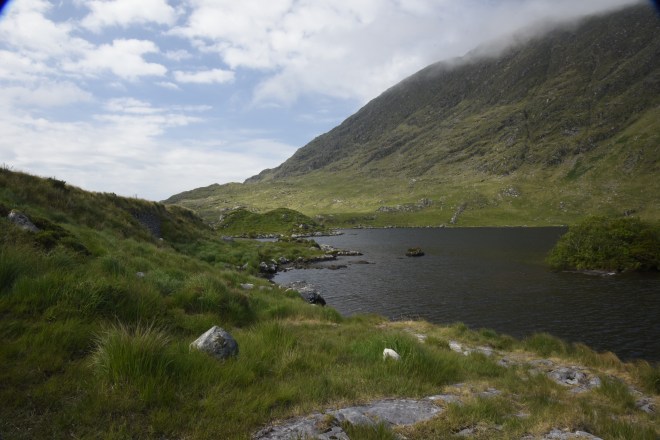
_DSC0721Scenery on the way to Killarney

_DSC0733
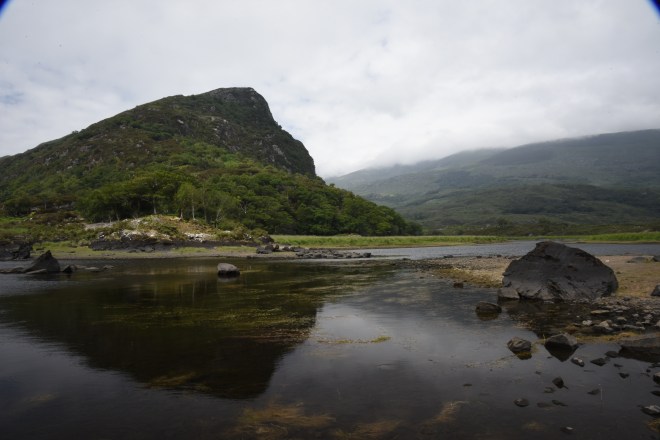
A lake in Killarney National Park

Trees in Killarney National Park
_DSC0766

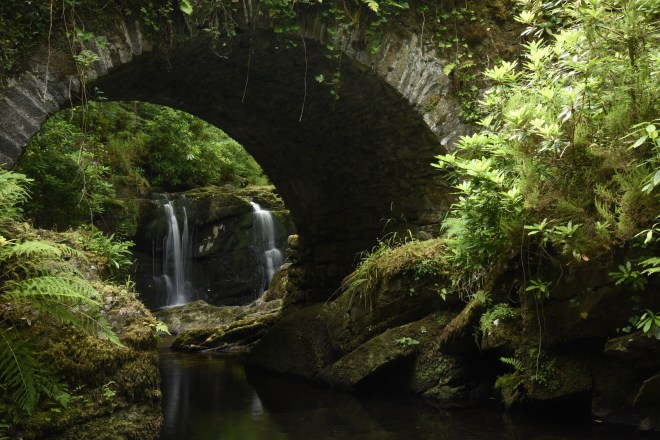
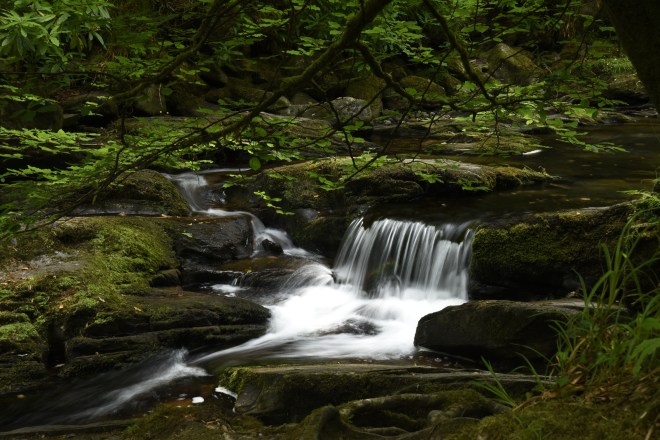
_DSC0762Torc Waterfall

_DSC0776

_DSC0784

_DSC0788

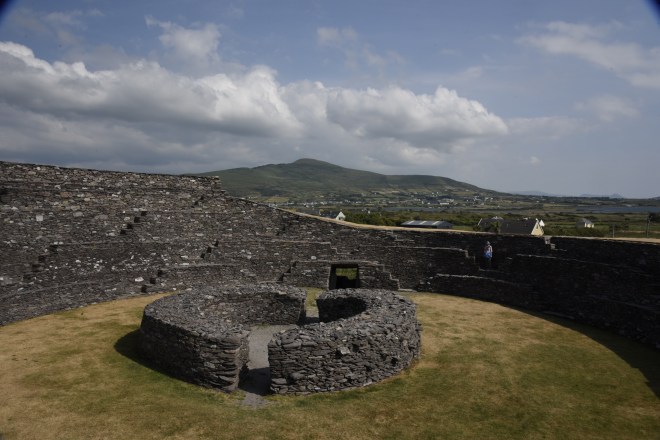
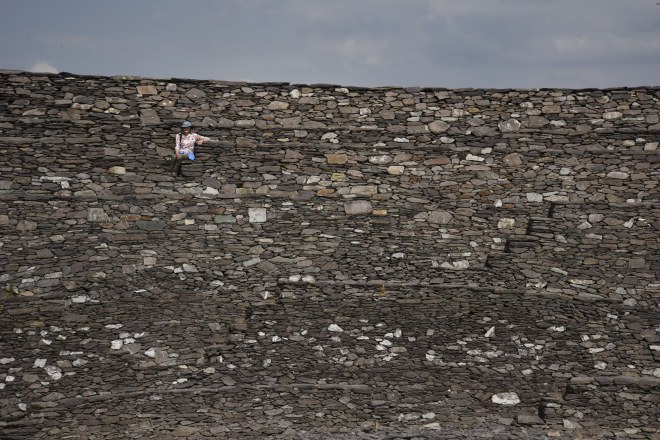
_DSC0781Ring forts (Circa 500 AD) near Cahersiveen on the Kerry Ring
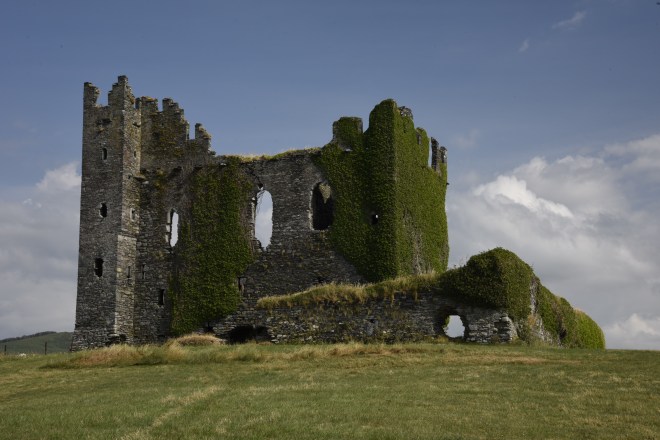
_DSC0799Ballycarbery Castle near Cahersiveen on the Kerry Ring. A few hundred meters from the ring forts. This is on private property.

Thursday, July 12
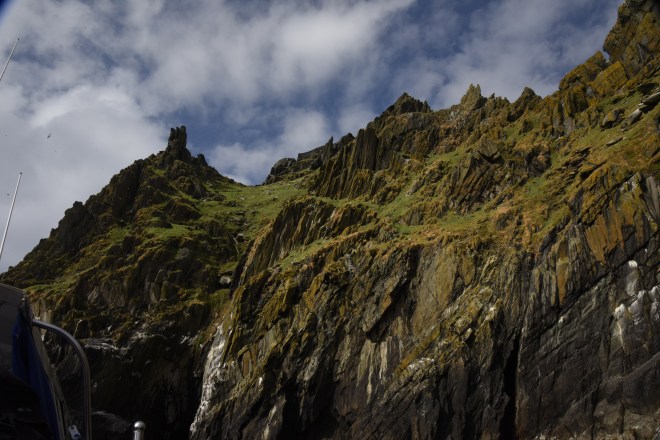
This was a major highlight for me. I rode a boat out to Skellig Michael, a U.N. World Heritage site with a monastery used continuously from about 600 A.D. to 1200 A.D. It took us about an hour cruising at 12 knots to get there. About eight miles out in the Atlantic. The monks rowed little leather covered boats. At least they didn’t have to contend with roundabouts. The island was also used by Steven Spielberg for the filming of Star Wars. Talk about a time span.
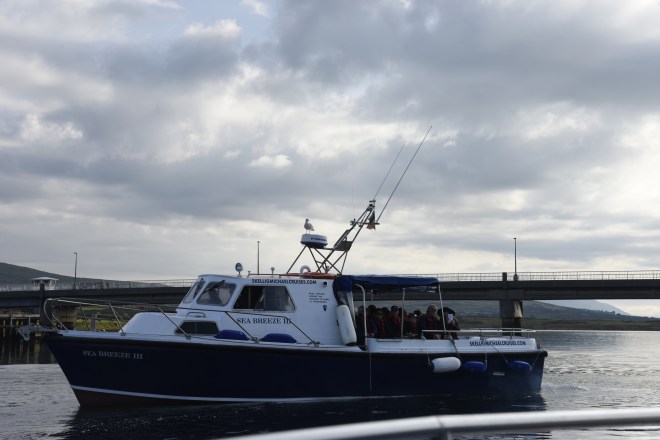
_DSC0805Our sister ship.

_DSC0812

Approaching Skellig Michael.

_DSC0813

Looking up from the boat landing. 600 steps up to the monastery. Steps that were installed in 600 AD.

The monastery.
_DSC0856

_DSC0860

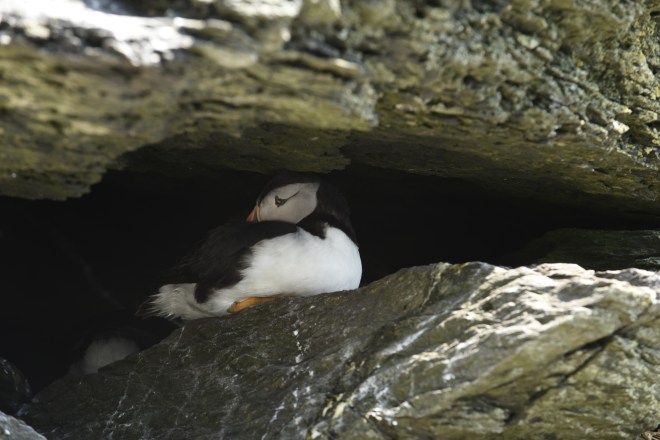
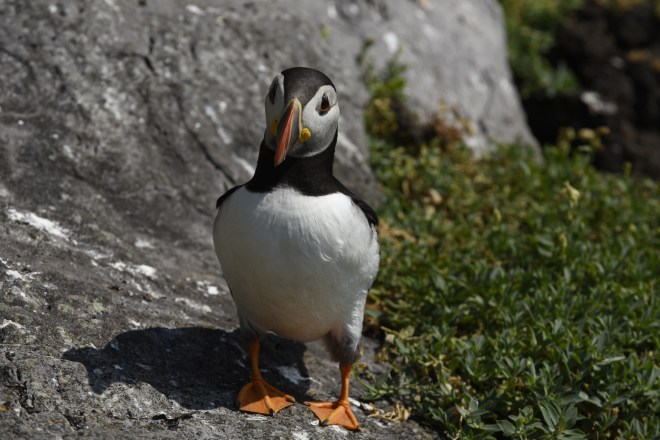
_DSC0861Atlantic puffins that nest on Skellig Michael.

_DSC0888

_DSC0880_DSC0876

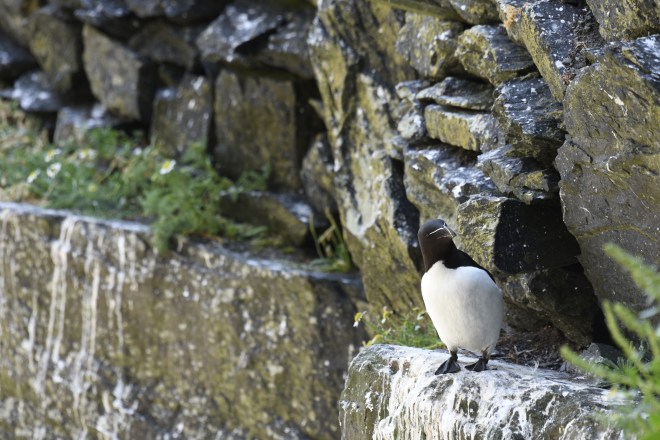
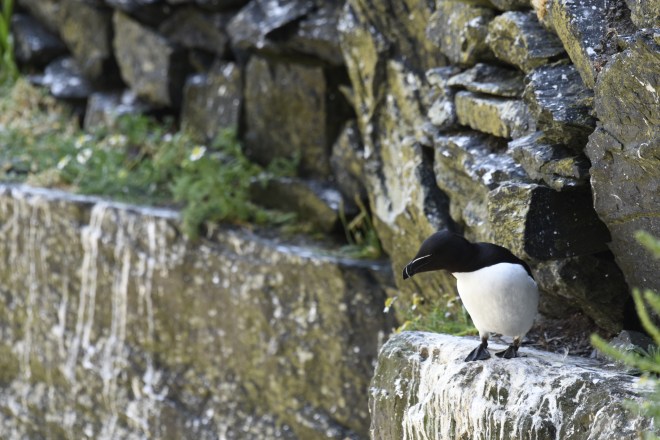
Razorbills, which also nest on the island.

After Skellig Michael we drove back to Dublin for the night and had dinner at Arthur’s Pub. Arthur’s has been a pub for over 200 years, and has some historical connections. It is right by St. Catherine’s Church, outside of which the patriot, Robert Emmet, was hung, drawn and quartered in 1803. Probably for inventing roundabouts. His death mask hangs on the pub wall. Arthur’s is also the closest pub to Guinness. There’s a rumor that they have a pipe running right to Guinness so they can supply the freshest draft outside of the brewery.

Friday, July 13
We grabbed Lindsay and headed to the City of Tribes, Galway. Mostly we just cruised the Shop Street area.

_DSC1037I love it. 1651. Still has some of the original walls in the pub.

Saturday, July 14
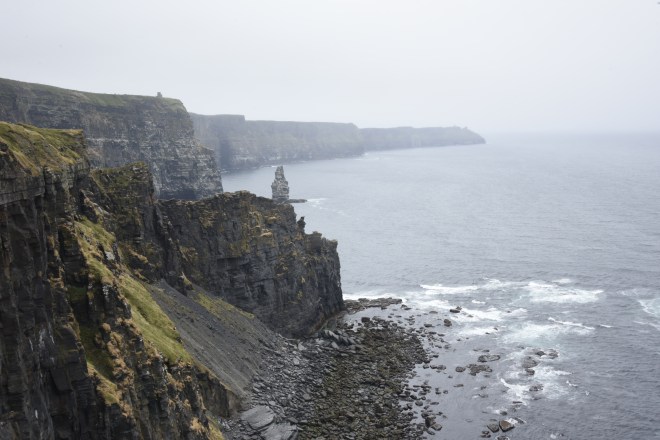
Saturday, we drove to the Cliffs of Mohar, the legendary Brian Boru’s hunting grounds. A stunning place used as a backdrop in a Harry Potter movie. I found myself wondering what it was like to be a Celt standing at the edge of the cliffs.

_DSC0991

_DSC1001The Cliffs of Moher.

IMG7846752115106278197Lindsay on the Cliffs of Moher

IMG2617824397811341687Me on the Cliffs of Moher

After the cliffs we back into Galway for a little shopping. Lindsay bought me a hat from O’Maille’s. They have been hand making woolen clothes for 75 years and supplied the costumes for John Wayne, Maureen O’Hara, and Victor McLagan in the movie “The Quiet Man”.

O'Maille quiet man

Quiet Man picture from O’Maille’s. Not my picture.
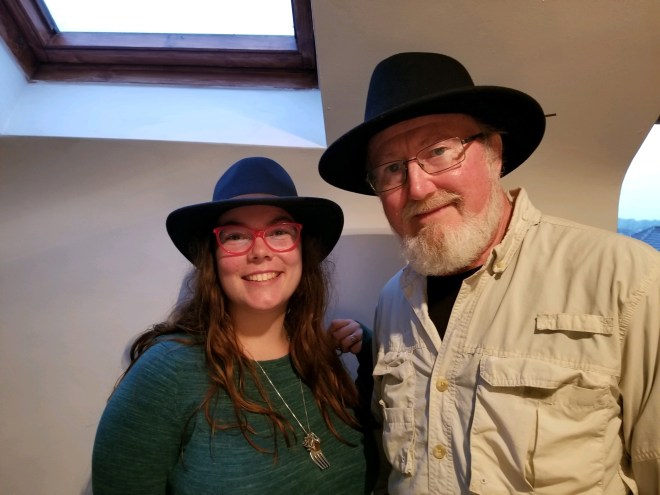
IMG3626957485733590389Our hats from O’Maille’s.

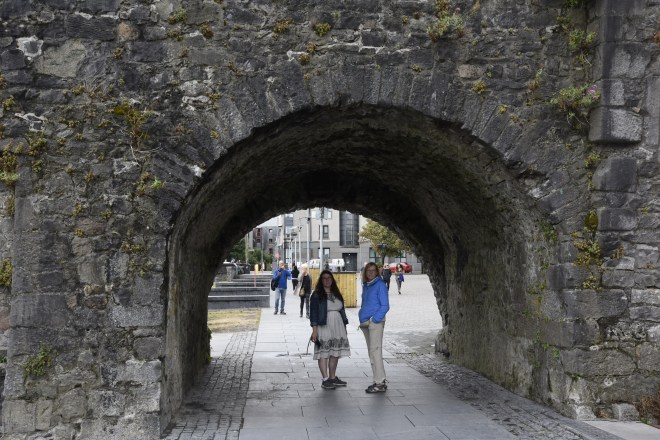
_DSC1033Lise and Lindsay under the Spanish Arch (1584). Part of a defensive wall to protect business in Galway from raiders.
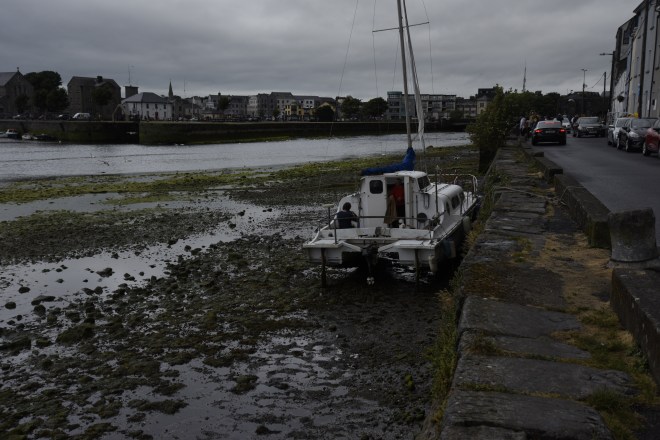
_DSC1031Nowhere to go until the tide comes in.

Sunday July 15
We drove back to Dublin for the last time. On the way we stopped in Tullamore at the Tullamore Dew distillery. Learned interesting things about one of my favorite whiskeys and Irish distilling in general. And got to taste a range of their whiskeys at the end. I ended up buying a bottle of a version they only sell right at the distillery. You can’t buy it anywhere else in the world. Problem is, with that lineage I’m never going to want to crack the bottle open.
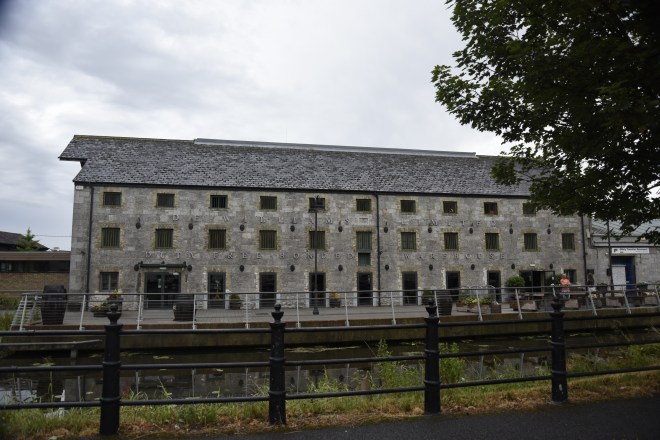
_DSC1039The old Tullamore Dew distillery, now the showroom.

After the distillery tour Lindsay navigated us through Dublin right to her dorm. Either my driving improved or we all got numb to near death experiences. We returned the rental car with no dents, something I attribute to some form of divine intervention. More likely the whiskey tasting.

Later that evening we had an experience that sort of said everything about the trip. Lise and I were looking for something to eat and started at a pub about a half block from our lodging. They didn’t serve food but directed us to some other establishments. On the way back to our lodging we stopped at the pub to have a couple drinks. Talked to the bartender and watched some Gaelic football and hurling matches on the tube. Came time to pay and the pub didn’t have a charge card system set up. We didn’t think we had enough Euros so the bartender said, “Don’t worry about it. If you’re coming back tomorrow you can just pay me then.” He said this to two total strangers that he knew didn’t live thereabouts. Where in the States is something like that going to happen? As it turned out, we did in fact have enough Euros to pay our debt.

Monday, July 16
Lise and I spent a relaxing day cruising around Dublin Town, catching some of the sites we didn’t have time for during other visits. Most notably we saw the book of Kells and the Long Room, Trinity College’s famous library. Seeing the book of Kells was worth fighting the mobs. On Lindsay’s advice we booked tickets online the night before and got the earliest time slot we could. We showed up 45 minutes early and they went ahead and let us in. The lines were three times as long when we came out of the library.

IMG_1217

_DSC1050

The Long Hall library at Trinity College. Inspiration for the forbidden library in Harry Potter maybe?

We also did the epic Emigration Museum, guaranteed to make you dislike the British, and St. Stephan’s Green. Guaranteed to make you dislike the British even more.

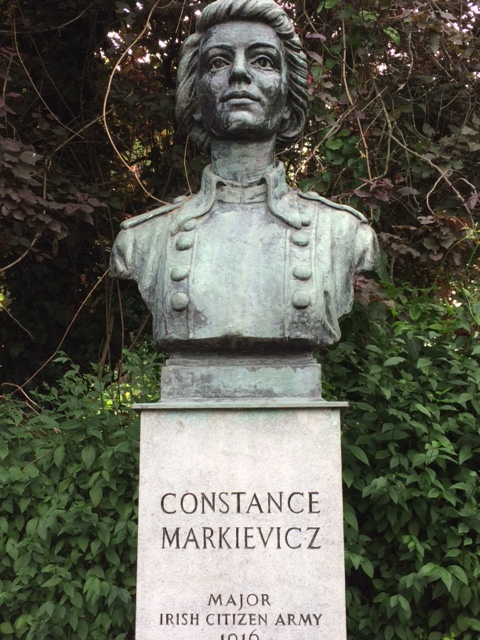
They did an excellent job of conveying the importance of the Green during the Easter Rising. Very simple low-key signs but very powerful. I remembered St. Stephen’s Green in my reading about the Rising. To be there was moving.
IMG_1220

She led a contingent of troop at Stephen’s Green during the uprising. Legend has it she kissed her pistol before surrendering it to the British. Sentenced to death, her sentence was later commuted.

_DSC1061A pub established in 1620 where we ate lunch.

_DSC1058

_DSC1060St. Pat’s Cathedral. A church has been on the site since 1200.

_DSC1066The Samuel Beckett Bridge in Dublin. Anyone can build a bridge. Why not make one in the shape of a harp, the symbol of Ireland.

Tuesday, July 17
The long trip back.

IMAG0054The parting glass, Dublin Airport.

Tuesday, July 3

We are in a Holiday Inn in Toronto, Canada, waiting for a plane to take us to Ireland tomorrow. Life has been crazy hectic with last minute details, so we are sitting like a couple of vegetables, completely mellow with some cheap wine.

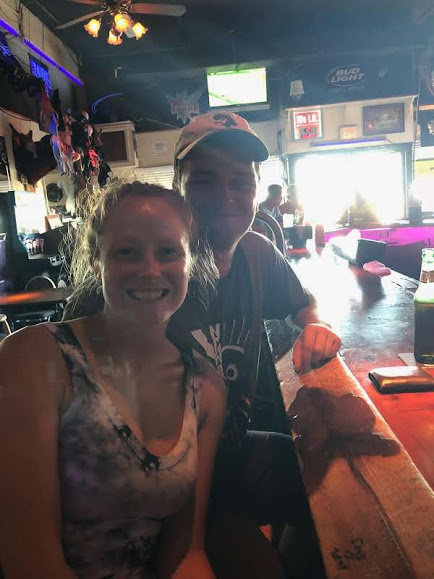
On our way here we stopped at Port Huron to set up our cell phones for Canada. Molly and Mitchell are cavorting about in Delaware. Stay with me here, Port Huron and Molly & Mitchell in Delaware tie together. Today was a major putt-putt golf day down in Ocean City with Anita, mostly to see if Mitchell was worthy of the task. While we were eating our ice cream in Port Huron, Molly sent a “guess where we are” picture. Which we immediately recognized as the iconic Ocean City bar, the Purple Moose. To put things in perspective, when Lise and I first started together 25 or so years ago she noted that I wore a Purple Moose T shirt at least once a week. Sometime more. When Molly sent her “where are we” picture, I got to send back from Port Huron a “look what I’m wearing” picture. Should I be worried that my daughter now habituates bars that I habituated 30 years ago?

purple moose

Guess where we are?

IMAG0034

Look what I’m wearing?

The other big doings around Okemos is that one of our yard Nazi neighbors called in a complaint about the brush pile and tall grass in our back yard. We came home from Oregon with a notice that we had a nuisance in our back yard and we had to clear it up or the township would come in and do it for us. And then make us pay for it. A lousy brush pile that the local critters just loved. It’s enough to make one go Libertarian. I am so ready to leave Okemos. So, between getting ready for our trip and sterilizing our yard we haven’t had time for much else. About the only other highlight would be our lizard Rover trying to evolve into walking upright. I recommend against evolving because it just means you will need to keep your back yard clean and tidy to not offend the yard Nazis.

IMAG0032Trying to evolve. Unlike the Republican Party.


Sunday, June 24, 2018

We spent the past week in Oregon, for a wedding of my niece Katie. Who took her first steps in my cabin down in Indiana. About 25 years ago. And I got to play with my youngest niece, another Katie. Fun stuff.

katieMy niece Katie. I used to have hair that color. Now I’m happy to have any hair.

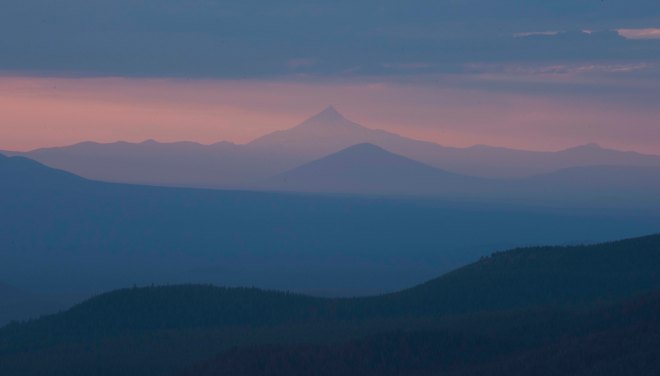
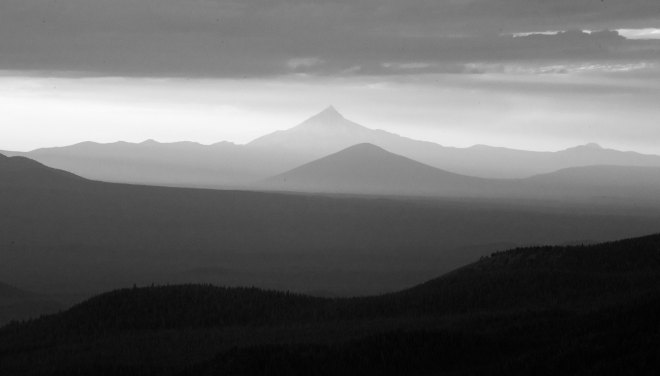
We liked Oregon. There’s some big open country there, with views you will never see east of the Mississippi. Lots of opportunities to play with the camera.

not in kansasTypical views. We’re not in Kansas anymore Toto.

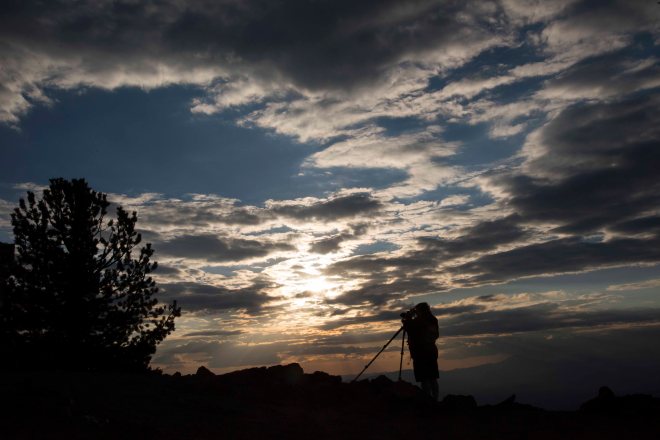
anitaMy sister Anita taking sunset pictures on Paulina Peak.

sunset colorSunset from Paulina Peak in color.

sunset BWSunset from Paulina Peak in shades of gray.

misty morningMisty morning outside our cabin.

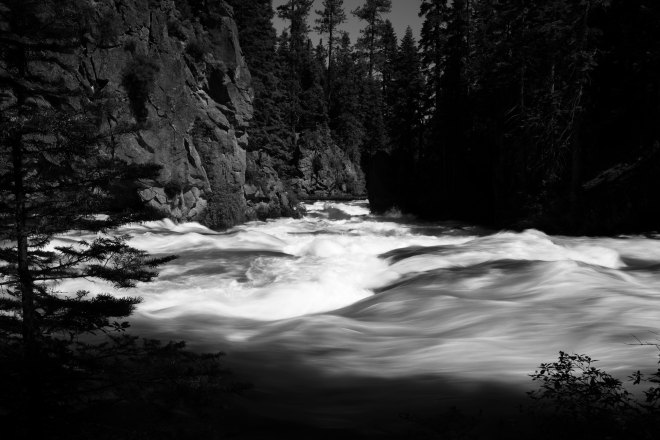
Benham Falls1Benham Falls

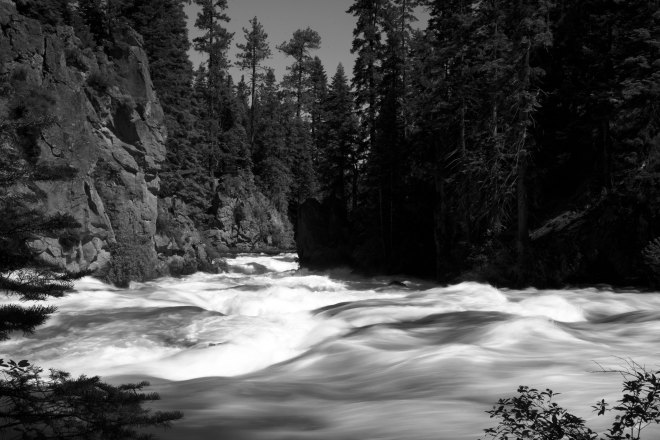
Benham Falls2A slightly different view of Benham Falls.

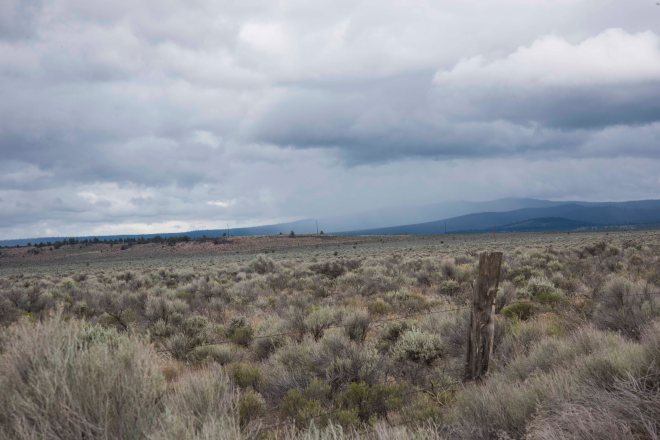
We were a bit south of Bend, Oregon, on the dry side of the Cascade Mountains. When most people think of Oregon or Washington State, images of wet rain forests with huge moss-covered trees pop up. In reality, most of the state is on the dry side of the Cascade Mountains. And I do mean dry, as in sagebrush, tumbleweed, and desert dry. We went chasing burrowing owls out in the desert around a volcanic feature called Fort Rock. This place was isolated, and was day use only, but had a host living in a camper. Interesting retirement gig if you hate being near people. Just you and the coyotes. We didn’t get the burrowing owls, but we did get some good species like Swainson’s hawk, ferruginous hawk, golden eagle, black-billed magpie, sage thrasher, sage sparrow, Western meadowlark, and Brewer’s sparrow. Not species we’re going to find in Okemos.

desertThe open desert, about an hour east of where we stayed.

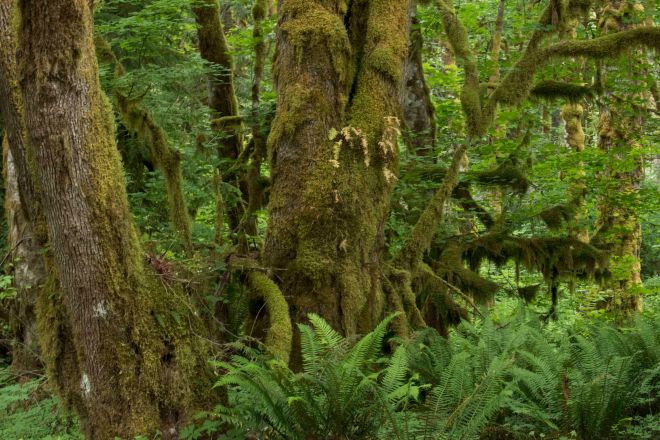
rain forestFor contrast, a quick rain forest shot, about two hours west of where we stayed.

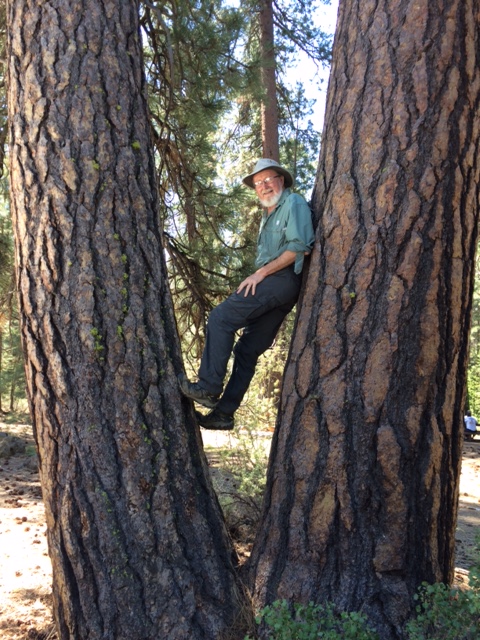
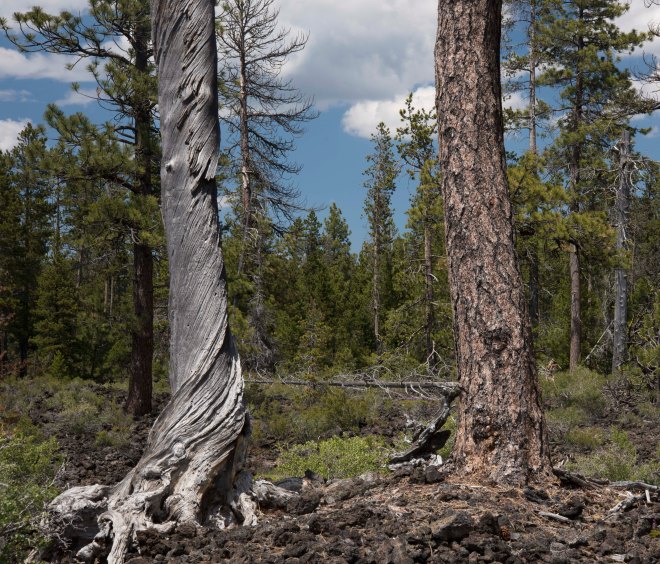
The whole place isn’t desert though. We were in the land of the ponderosa pine. Some serious big trees. Most of the area where we were had been heavily timbered in the past. I don’t think we saw any significant virgin timber. There were a few pre-European trees around though, and some places with trees maybe a hundred years old. Enough to give you an idea what was once there before we turned it into plywood and paper towels.

IMG_1176

Big trees. (Lise photo)

If you are a volcano enthusiast, this is the place to go. We played around in the Newberry Caldera, which last erupted about 1300 years ago. It is still considered an active volcano and is monitored the U.S. Geological Survey as such. In the caldera we hiked the rim of one volcanic crater and walked on an obsidian flow.

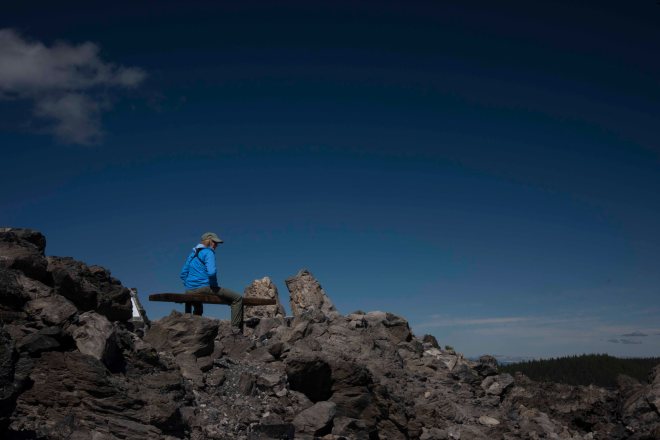
liseLise on the obsidian flow.

lava field tree 2A lone tree growing through the obsidian.

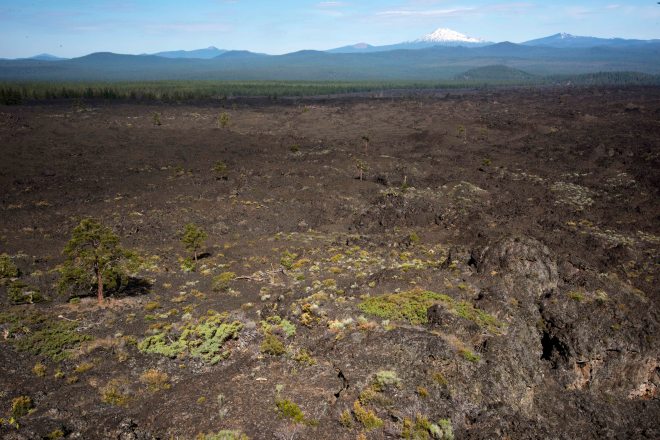
A few miles north of the Newberry Caldera area is Lava Butte. There we were walking on lava flows 7,000 years old. You get to observe a process in ecology called primary succession. This is a situation where vegetation is wiped away, but there is no soil. Only bare rock.  Secondary succession, by contrast, is where vegetation is wiped away by some process like a flood, but there is soil still in place.

7000 years7,000 year old lava flow.

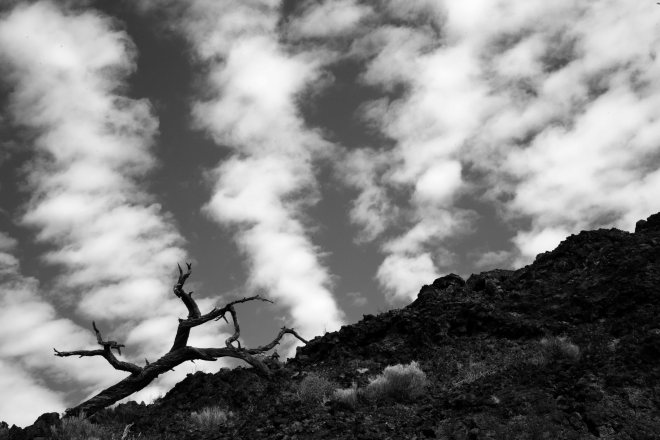
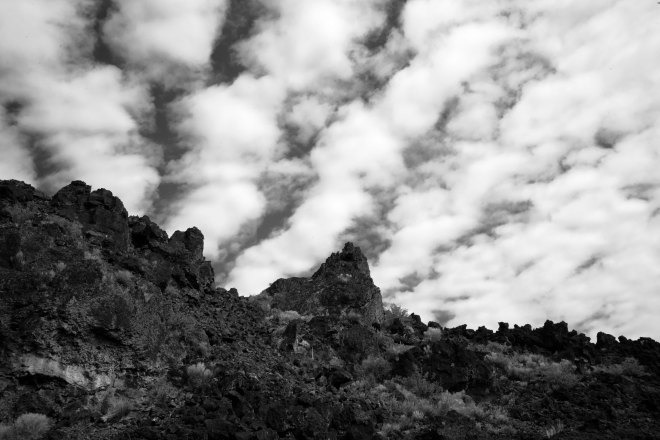
lava field treeLava flow and clouds.

lava and clouds1Lava flow and clouds.

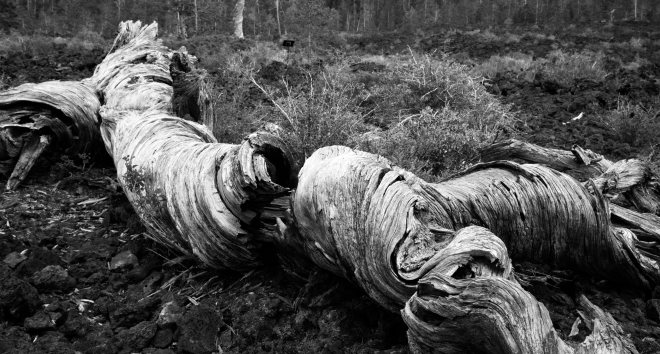
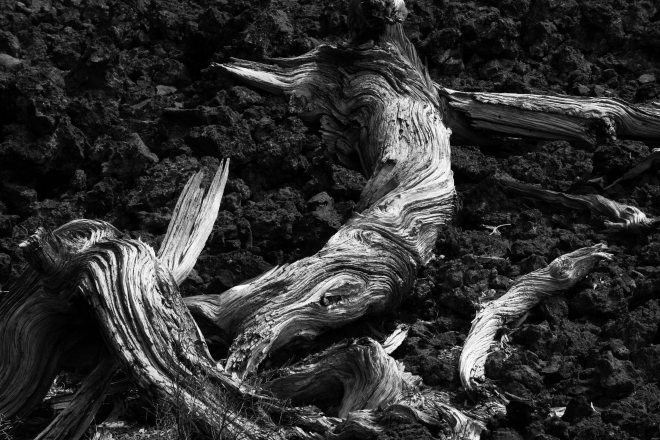
When these volcanoes erupted, there was vegetation place. At the lava cast forest you can see tubes where the molten lava hit ponderosa pines 7,000 years ago. The water in the pines cooled the lava to form a tube, but the tree still burned away. After the eruption there was nothing but lava that cooled to stone. So now, a few thousand years later, these places are still mostly barren. There some lichens and small plants, but very few trees. The ponderosa pines and an interesting adaption for these conditions. Since soil and water is so rare, the tree has only one root that seeks water. The other roots only serve to anchor the tree. Then the tree grows in a spiral, so the water and nutrients are distributed to all sides of the tree.

Down in the cast of a 7,000 year old ponderosa pine. Where I’m probably not supposed to be.

twisted tree2Twisted ponderosa pine.

twisted tree1Twisted ponderosa pine.

twisted treesTwisted ponderosa pine.

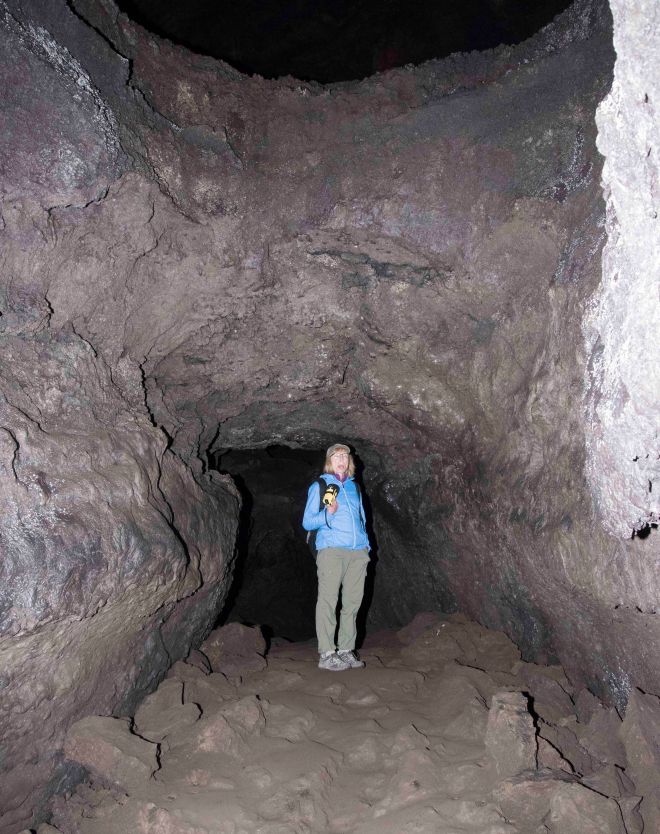
One of the most impressive volcanic features was an underground, mile long, lava tube. The tube was longer, but only a mile was accessible. The tube was formed by lava forcing its way through an underground channel, melting the channel as it went. the outside of the lava cooled and hardened while the interior stayed liquid and flowed out. The tube we were in had some chamber roofs that were an easy 50 feet high, and the roof was 30 feet underground. This was a rather pleasant way to go caving. Walking upright in a dry channel. Only once or twice did you have to even bend over a bit. The tube had such a large volume it would take a biblical flood to fill it up.

tube entranceLooking back at the entrance dropping down to the tube.

lava tubeLise in the tube. Maybe a half mile in.

double tubeOne tube on top of another.

end of caveA nice little sign at the end of the accessible part.

We learned a new Scrabble word too. Kapuka – a Hawaiian term to describe an island of vegetation that was not obliterated by a lava flow. Goes great with other Hawaiian terms describing lava like pahoehoe and aa. Great terms to know when you have to get rid of a bunch of vowels.

Birding was good. Lise got 29 species for the year and I got 30. Lise is at 215 species for the year and I’m at 213.

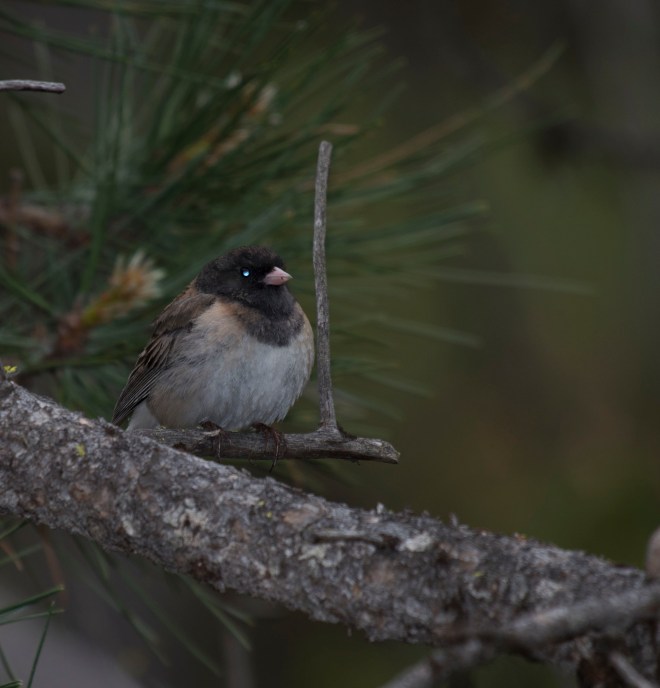
Oregon juncoOregon junco. Now grouped in with other juncos as the “dark-eyed junco” so it didn’t count as a new species.

Warning: Following is an anti air travel tirade. Nothing really intelligent so feel free to ignore.

I also think I may have taken my last domestic airline flight. Mostly because of the inane security process. I don’t mind security, but paranoia helps no one. We now have the technology to quickly detect the minutest traces of explosives. The need to make everyone take off their shoes, without giving them a place to sit down, is ludicrous. Or that you can’t take a bottle of water or cup of coffee through security. When all it takes is a quick scan with existing technology to determine if that bottle of water is in fact a deadly explosive. What is really galling is that you can pay for a status that will get you through with minimal checks. Or if you are older than 75 or have disabilities you can get through quicker. So, if I’m a jihadist terrorist, I either pay a few bucks to get an enhanced status or recruit someone with a profile that gets a bye through security. It’s not like the security is particularly effective either. For all the indignities of removing your shoes and belts to find potential weapons, my sister-in-law got through security with an undetected pair of scissors. I once made it through with a straight razor.

Then add to the mix that the airlines try to milk every last cent out of you. At one time you could check two bags for free. Now there’s a fee for checking any bags. You are crammed into packed airplanes like sardines. Where they used to serve a small meal or snack, now they will sell you something to eat. I used to love flying. Now, it just isn’t fun anymore. I’m tired of the stupidity of the American aviation system. It might be time to start driving everywhere. It takes longer, but I can carry everything I want, and I don’t have to empty my pockets to go through a scanner. We’re flying to Ireland soon, but we are going to fly out of Toronto. Hopefully they’re a bit more intelligent about everything.

Monday, June 11, 2018

A lot going on since my last post. Having no visible means of support, one would think I have all the time in the world. Unfortunately, that doesn’t account for things like taking a week to fix a computer.  A computer that was working before Microsoft decided I really needed an operating system upgrade, regardless of the fact my computer was working fine. Microsoft’s supposed foolproof upgrade trashed my computer so bad I had to resort to reloading the whole Windows operating system. Which means I also had to reload all the software programs on my computer. Which means I had to suffer through all the messages saying my software was old and out of date and didn’t I want to update to something new and wonderful. To which I had to say, “Sorry, but I’m old and out of date too. But I still work, like these old programs work. They do what I need them to do, even if they’re not the latest and greatest.”

Almost as much fun as reloading the operating system has been repainting the downstairs bathroom. Doing the job right entails removing and reinstalling the toilet. That’s something right up there with root canals, colonoscopies, and the tRump presidency. It ain’t pretty, it ain’t fun, and it could go really bad.

That little exercise highlighted our interesting dependency on two bathrooms. Growing up, my family had nine people in the household, all using one bathroom. No heat vent going to it, but at least it was indoor plumbing. Everyone had to go through the boy’s bedroom to get to the bathroom. But we somehow managed. Now, with three regulars in the house, and an occasional fourth, there was some pressure to get that second bathroom back on line as soon as possible. So all is good now.

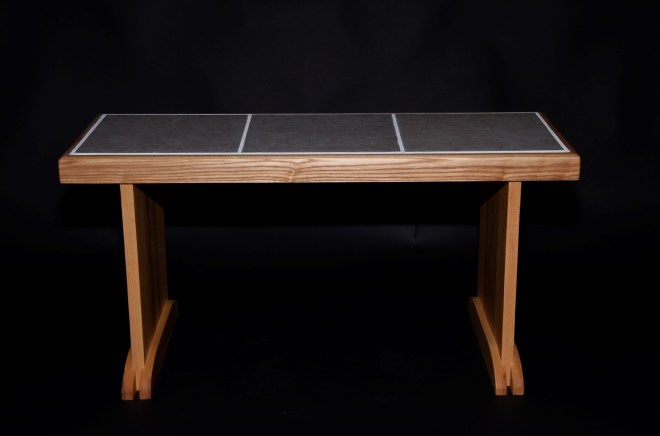
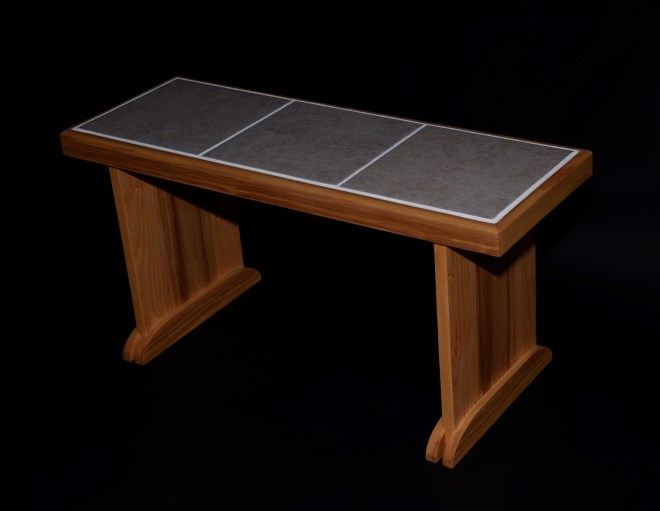
In the fun work category, I finished a tile-top bench I’ve been building for my sister Lynn. I used the same tiles as her kitchen floor and the wood, white ash, will match her hallway. This bench has taken me longer than I expected, but it has been a great learning exercise.

bench1bench2bench3

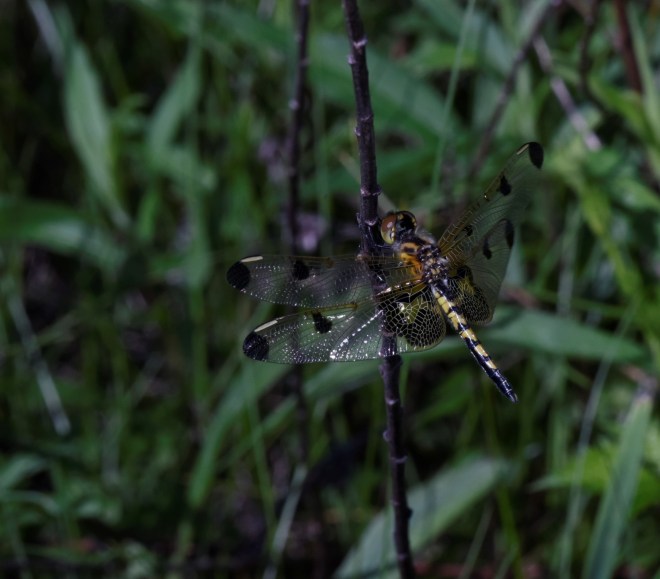
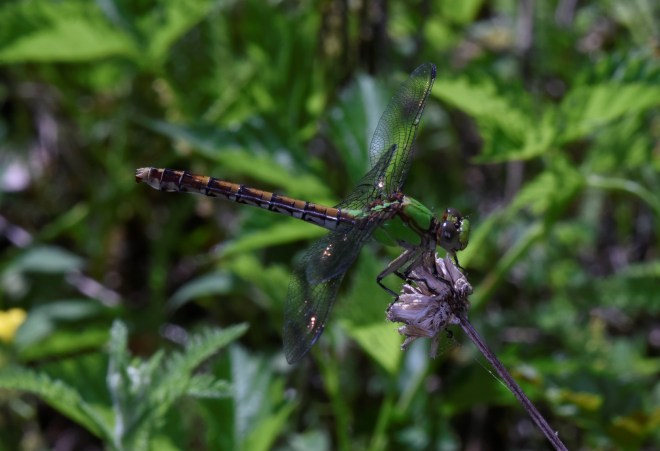
The time hasn’t been all work. I finally got out for my first odonating of the season. Went to Riverbend Natural Area by the Grand River for a couple hours. Saw some old friends like calico pennants and Eastern pondhawks and I got pictures of a rusty snaketail. The snaketail is a new species for me and not commonly seen here. The Michigan Odonata Survey has no record of rusty snaketail here in Ingham County.

_DSC9858Male calico pennant.

_DSC9834Female calico pennant.

_DSC9847Female Eastern pondhawk.

_DSC9842Rusty snaketail.

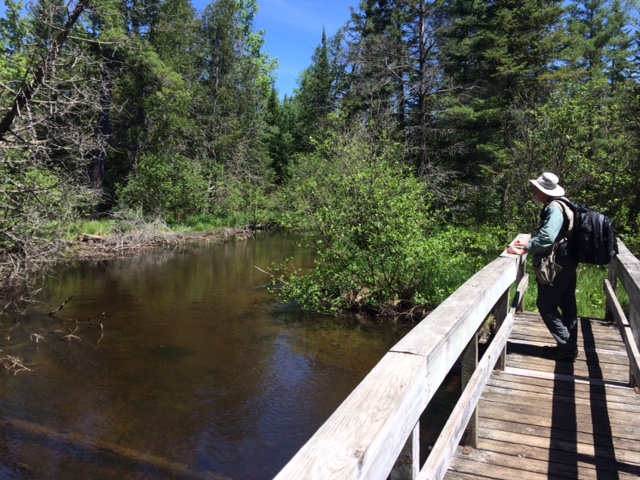
Lise and I got in our annual trip up to the Grayling area for Kirtland’s warblers. The Kirtland’s is a habitat specialist species, only nesting in young jack pines. Jack pines are an interesting species in that their cones need to go through a fire to release their seeds. Historically wildfires would kill off the older jack pines, but the seeds would sprout into the young jack pines preferred by the Kirtland’s. Once the Europeans showed up, jack pines were either harvested and fire suppression prevented new growth. Those that were not harvested became too old for the Kirtland’s to utilize. The Kirtland’s population plummeted, and they were on the brink of extinction until their dependence on the jack pines was understood. Now with proper management their population has rebounded nicely, and they may be de-listed.

IMG_1145Me, standing on a bridge over the Au Sable River.
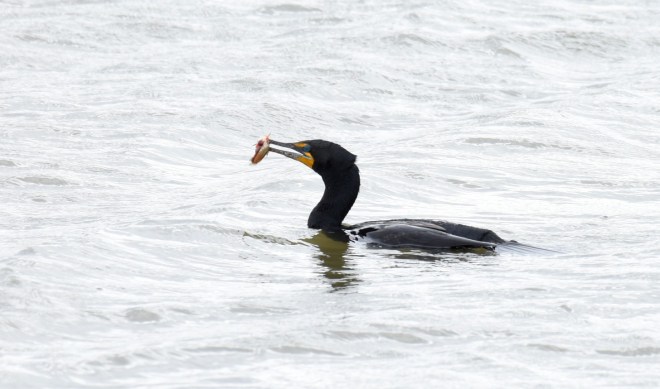
We have also gotten in some birding other places. Today we got a fork-tailed flycatcher in Flushing, Michigan. This was a life bird for both of us. The flycatcher is a South American bird, never seen before in Michigan. Needless to say, people have come from far and wide to see it.  We’ve also been getting some of the less exotic species. Lise is at 179 species for the year, and I am at 174. Not big year numbers, but respectable.  And more to come.

CormorantDouble-crested cormorant eating a fish. Shiawassee NWR.

muskratMuskrat with vegetation.

Sunday, May 27, 2018

We are back in Okemos, drinking the official summer drink, a gin and tonic, after a six-day, three state, road trip. Lots of miles, good people, some decent birding, and a transition into summer. We left with early spring temperatures. We got back, and it was high summer and praying to the great air-conditioning god.

Tuesday, May 22, we drove to West Lafayette to spend the night with Sue and do some errands. Soaking up the Indiana humidity on the porch at Littleton Street we heard our first nighthawks of the year.

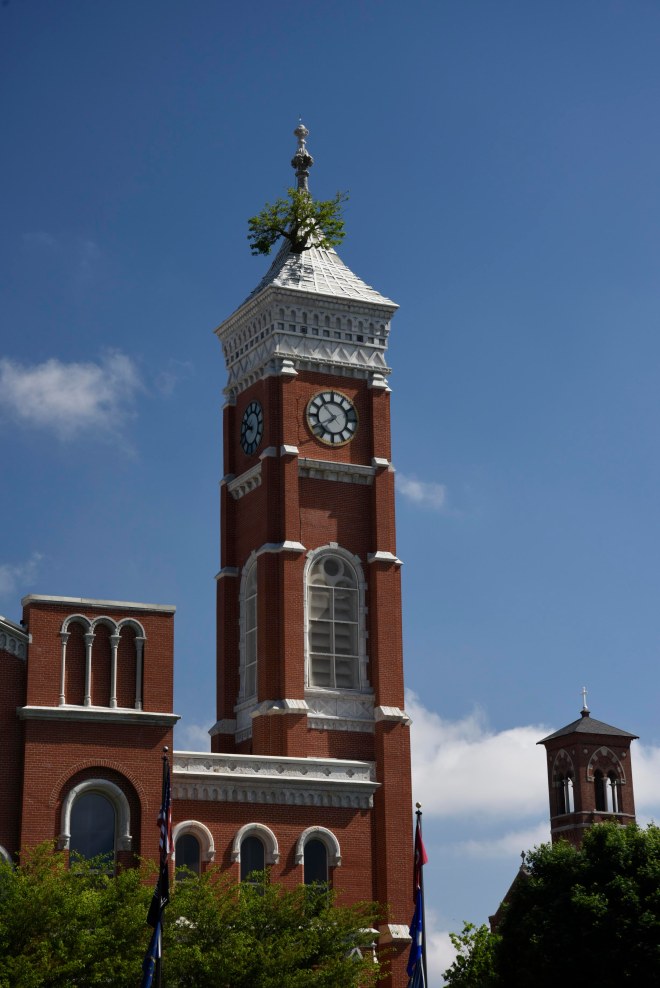
Wednesday morning from West Lafayette it was over to Fort Benjamin Harrison State Park to drop of Bob’s WWII dress jacket and journal for their museum. Then it was down to Versailles State Park for some work Lise is doing at the park. With a stop for lunch in Greensburg, IN where they have a tree growing out of the courthouse roof. And have had a tree growing from the courthouse roof since 1888. At Versailles we got a yellow-breasted chat, rough-winged swallow, and willow flycatcher. Also, a couple neat dragonflies I couldn’t ID without my field guide. Didn’t take it because it’s been too cool for dragonflies in Michigan.

greensburgGreensburg, IN courthouse with a tree growing from the roof.
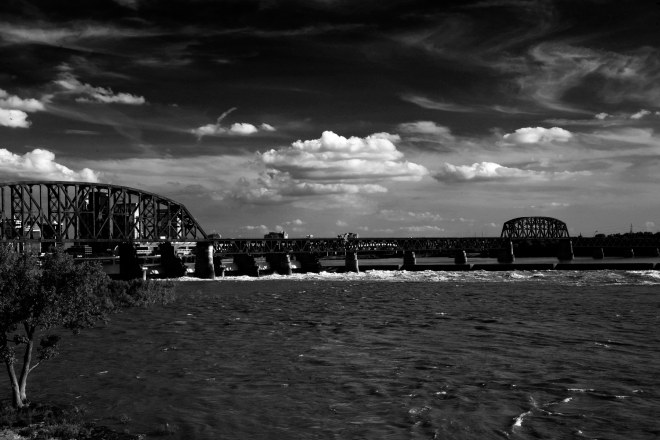
From Versailles we took a side trip to Madison IN where we got black vulture and purple martin. After Madison it was down to the Falls of the Ohio near Louisville KY. These falls were likely never very impressive, as in cascades of water falling over large cliffs. It was more like a small ledge that made a rapids. Buffalo could cross the river there, but boats and barges couldn’t get up and down the river. So, with the typical treatment of anything that impeded progress, we put some dams and a canal in place to castrate the river and let barges get through.

There is some history associated with the Falls. This is where Merriweather Lewis met William Clark before starting their exploration of the Louisiana Purchase. Also, John James Audubon spent time there, and collected bird specimens locally. The Falls area also has some famous fossil beds, but when we were there the water level was high enough to cover them. After the Falls it was on to Corydon, IN for the night.

fallsFalls of the Ohio. Interstate 65 bridge with Louisville in the background. It may not look very impressive but that small drop was a major hindrance to navigation. It’s now bypassed by a dam and canal.

fossil1Fossils by the falls. The famous fossil beds were under water when we were there.

Thursday morning, we started at Hemlock Cliffs, one of my favorite places in Indiana. It’s a rare gem of a place in a state better known for corn, the world’s longest left turn, and homophobic politicians. In a good wet season, one can get up into a large shelter cave behind a small waterfall. Unfortunately, the waterfall was dry. Birding was good though. We both got wood thrush, worm-eating warbler, yellow-throated warbler, Acadian flycatcher, summer tanager, hooded warbler, and yellow-billed cuckoo. Lise also scored Louisiana waterthrush and a screech owl.

hemlock1The shelter cave, without a waterfall.

hemlock2View from inside the cave, looking down the canyon.
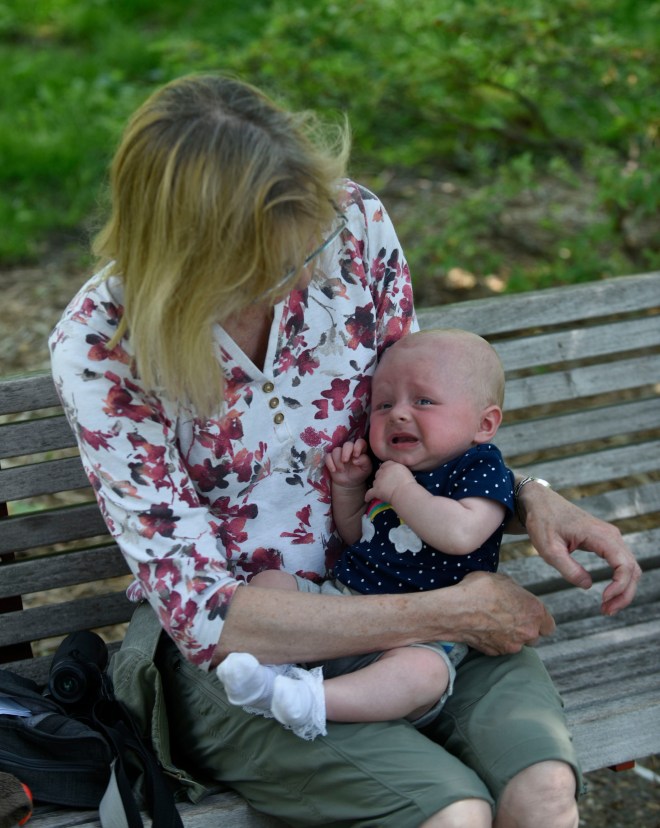
From Hemlock Cliffs we drove over to St. Louis for a couple of nights to see baby Ava. Oh, yeah, Stefan and Kasey too.

lise and avaLise with baby Ava.

IMG_1140

Me with baby Ava. Easy to see which person she like best. (She likes whoever holds the bottle. — Lise)

St. Louis is can be a great place when you have good guides. We did the Missouri Botanical Garden, Citygarden sculpture park, the historic court house where the infamous Dred Scot case started, the Arch, and the Soulard Market, a market since 1779. All in a day and a half. Plus, some good chatting, playing with Ava, eating, and drinking. I would definitely put St. Louis in the “drinking town“ category.

_DSC9788_DSC9787_DSC9780_DSC9772_DSC9770_DSC9768_DSC9767_DSC9761

Plant pictures from the Botanical Gardens.

dome

Laying on the floor, looking up through the dome of the historic courthouse. I’m betting Dred Scott saw it in an entirely different light.

arch

The Arch.

Leaving St. Louis yesterday morning we hit Horseshoe Lake State Park across the river in Illinois.  There we got great egrets and, of special note, the Eurasian tree sparrow. The St. Louis area is one of the only places in the continental U.S. where you can reliably find the Eurasian tree sparrow. From St. Louis it was back to West Lafayette for a night.

This morning, after a stick to your aorta breakfast at West Lafayette’s famous Triple X Diner, we did a quick trip to Prophetstown State Park where we got dicksissel, Henslow’s sparrow, sedge wren, and blue grosbeak. A short visit with Fred and Jackie in Fremont IN, and we are back where we started six days ago. Home again, home again, jiggity jig.

Tuesday, May 22, 2018

Been having a hard time writing lately. Beside the usual laziness. We have just plain been busy. Some of it good, and some of it not so good.

On the up side, the mid-Michigan version of Spring has finally come our way. Gray and rainy, but at least the temperatures are above freezing. And the plants and animals are responding appropriately. Trees and plants seem to have blossomed out overnight. The migrating birds have been coming through and the nesters are setting up shop. We have gotten out a few times in the past couple weeks, even though the conditions were less than ideal. Our warbler count is mediocre but, a couple days ago we got an orange-crowned warbler. That one was a lifer for both Lise and me. This morning we got a least bittern, a lifer for Lise. I’ve gotten two lifers this season, the orange-crowned and the yellow rail. Lise has gotten those two, plus the least bittern.

bluebird1

Eastern bluebird checking out the accommodations.

bluebird2

Standing guard.

white-crowned1

white-crowned2White-crowned sparrows migrating through our yard.
house sparrow1

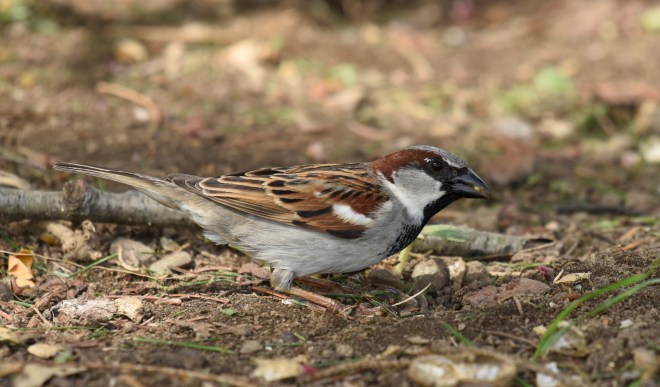
house sparrow2House sparrows. Common, but still handsome.

fat boyFat boy the groundhog and a progeny sitting on our brush pile.

red squirrelA red squirrel in our yard. Can you tell it’s a lactating female?

As a graduation present we threw a Cajun shrimp boil party for Molly and her friends. A bunch of work and a bunch of fun. Think of a pot of boiling red liquid that has among other spices, a one-third cup of cayenne pepper. Filled with potatoes, corn cobs, sausage and of course, shrimp. Eight pounds of shrimp. Along with a pile of other food and refreshments. I think we have kept some breweries in business. A good time was had by all, even the vegetarians.

I’ve also been busy doing things for Mid-Michigan Land Conservancy. I’ve served on the board for a number of years now.  We have always been an all-volunteer organization, but we have pretty much maxed out what we can accomplish as volunteers. I’ve taken on a fundraising project to get staff for the organization. Grants for organizational capacity building are tough to get. Foundations are much more likely to fund the purchase of a property because that’s a very tangible outcome. Hiring staff just isn’t as glitzy as buying a nice hunk of dirt. Fundraising is not what I would call my area of expertise, but we just got word that a foundation has awarded us a $20,000 challenge grant. Which means they will match, up to $20,000, any other funds we raise.

Now the not so nice stuff that needlessly eats up time. Like the automatic Windows 10 operating system upgrade. The one that has the nice messages like, “You’re going to like this”, “Just leave everything to us” and “This will make you much safer on the internet”. Apparently, Microsoft’s way to make me safe on the internet is to make sure my computer will not turn on. It’s a genius approach when you think about it. If you can’t turn on your computer, you can’t get on the internet, and the internet can’t hurt you. The real pisser is that you must go on the internet to find out what’s wrong and how to fix it. After a couple days of troubleshooting, trying fixes, and a lot of swearing, I finally got it down to what is called a sihost.exe. error. This is not good. A sihost.exe error is like trying to go ashore from a cholera ship. Nobody wants you and you’ll probably die before it gets better. At best they’ll burn your body to keep it from spreading.


Sunday, May 6, 2018

Yesterday, Molly graduated from the Lyman-Briggs residential college within MSU with a Zoology major and two minors; Spanish and History, Philosophy, and Sociology of Science. She graduated from Lyman-Briggs with High Honors and was also in the Honors College. She was invited into the Pi Beta Kappa honor society which neither Lise nor I were ever invited to join. All while playing water polo all four years, and working in an entomology lab for two years. Now it’s on to Temple University in a PhD program. Damn right I’m proud of her.

_DSC9493

Molly somewhere in a sea of green.

_DSC9487

Receiving the coveted piece of paper.

_DSC9382

A happy graduate.

_DSC9561

The proud parents photo.

_DSC9566

On the deck at Harper’s.

_DSC9501

_DSC9543

_DSC9544

Molly and Mitchell, on to bigger and better things.

Thursday, May 3, 2018

Greeting from biggish years, our new blog site. This is blog is a carry-over from our biggish year blog on Tumblr (http://2012bbiggish-year.tumblr.com/). Tumblr got a little stupid with their age verification and people without Tumblr accounts could not view the blog. Users would see a message that said something to the effect of. “This site has inappropriate content.” Not sure what the Tumblr definition of inappropriate is. Maybe using the common name of birds and not the scientific name? That’s not an American robin you fool, it’s Turdus migratorius. So, it’s time for a fresh start.

I have ported all the Tumblr posts over to this new site. The formatting is a bit verkehrt (mixed up) so I will be editing the older posts as I go. Onward and upward!

Ed & Lise 030411

This is just a test image of Lise and I to see how to add images.

Friday, April 27, 2018

We did a quick trip to Lynn’s place in upstate Pennsylvania. Where the internet goes to die. No cell service or internet connection.

I-80 rest stop in the snow. This is late April. Something is wrong here.

We only stayed a few days. First there was no waterpressure. Finally figured out the problem was the water filters. They were clogged with silt. This was like mud. Changing the filters took care of the water pressure but that’s a temporary fix. Silt doesn’t belong in the water system. Then we ran out of heating oil and it was going to be several days before any could be delivered. So we scurried back to Okemos.

The highlight for me was finding the Schools family deer camp, a place we vacationed once as kids. I’m guessing it was originally built in the late 50s or early 60s. Dad wasn’t a dues paying member of the “club”, but did the electrical work for the cabin. Including running electricity to the outhouse so they could turn on an electric heater in the outhouse from the cabin. Not liking the typical claustrophobic style of outhouse my family built one with picture windows. So you had a view while you were sitting there. As my grandfather became less mobile the outhouse became his “deer stand”. After making breakfast and getting everyone off to the hunt he would go sit in the heated outhouse with his rifle and a stack of magazines. Not a few of which were Playboy. Needless to say I don’t think he ever got a deer from his deer stand.

Since dad wired the cabin he occasionally got to hunt there, and we got to use it once for a family vacation. This is one of the only places I can remember us going on a family vacation. With six kids and a grandmother, go figure.

My siblings playing in Cedar Run, later 1960s. I took this with a little Kodak Instamatic camera. Even back then I was interested in photography.

I was around 14 or 15 when we stayed at deer camp, so we’re talking about 50 year ago.  When I was in the area with Lynn last year we drove past a dirt road and something in  my brain clicked. I was pretty sure it was the road to the deer camp. So this trip Lise and  I explored a bit. We re-found the dirt road and as we started up it I started recalling  landmarks that would say if we were on the right road. Like the place where Cedar Run  was right by the road, with some riffles and a popular trout pool. Which we hit about  three miles in. Then I started describing what I remembered about the camp, and how it  was situated form the road, and where we played in Cedar Run. About seven or eight  miles in, we hit it. I was pretty happy dredging this up from the depths of my memory. It had been a long time and lots of other things had gone in and out of my brain since then. And more than a few brain cells killed off.


Cedar Crest.

The outhouse with windows. I saw my first bear right about where the driveway gate is located.

The original cabin burnt down about 25 years ago and was rebuilt. I peeked inside and it  looked about what I remembered from our visit there in the 1960s. And there was the aluminum siding outhouse with picture windows. How’s that for class?

A small waterfall entering Cedar Run.


A couple waterfalls flowing into Pine Creek. Pine Creek is larger than any waterway we  call a river in Michigan. It flows through the Pine Creek Gorge, also known as the Grand  Canyon of Pennsylvania.