Sunday, November 4, 2018

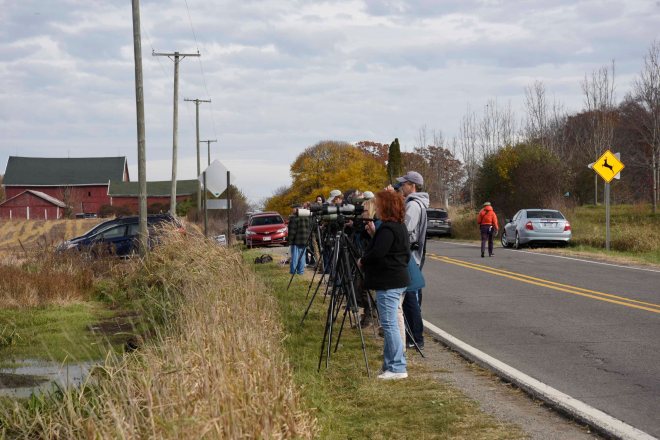
Big doings in the local birding world. We got us a life bird today. A spotted redshank has been discovered about an hour from where we live. This is a European and African bird, considered an American Birding Association Code 4 North American bird. That would be a continental rarity. Right at the junction of Parker and Scio Church Roads. Quite convenient, so we went chasing. As did many others. The local sheriffs were on site and quite willing to hand out tickets if you weren’t parked completely off the road. We only saw Michigan plates but by tomorrow I expect Indiana, Ohio, and Ontario birders.

This bird is not without controversy. The original finder posted pictures on Flickr but did not give a location. This riled the local birding community. With some detective work from the pictures, and knowledge of the finder’s birding habits, other birders located the site and the bird. Somebody publicly accused him of “rudely hiding this bird with malicious intent”, and the original finder is accusing others of hacking into his cell phone or Flickr account to discover where he was. Things get ugly when you’re dealing with ABA Code 4 birds.

redshank1Behind that log is a Code 4 species.

redshank2Lots of optics. Lise is the second person back., looking through the scope.

Tuesday, October 23, 2018

Home again, home again, jiggity jig.

We are back from our little West Lafayette – St Louis road trip. Friday it was West Lafayette for a visit with Sue and a business meeting for Lise. Saturday morning it was an artery clogging breakfast at the XXX diner and off to St. Louis. We were in St. Louis Saturday and Sunday night, then Monday we headed back to West Lafayette for the night. Now we’re back here in Okemos, staring blankly at each other. A quick little thousand-mile road trip made possible by Ike’s Autobahn, AKA the Interstate Road System.

Except for a lot of driving, the whole trip was kind of laid back. The focus was visiting family and that’s what we did. Spent time with Stefan, Kasey, and baby Ava. There was some play time. St. Louis has bunches of cool restaurants and brew pubs and we got to partake of some. Stefan and Kasey also took us to Cherokee Street with its funky shops. In a lot of ways St. Louis reminds me of where Molly is in Philadelphia. An older city undergoing something of a renaissance. Both have areas where you can find all the trouble you want. Neither is a place I would want to send my kid to grade school. But both have plenty of areas that give the place some soul. More so than where I am now.

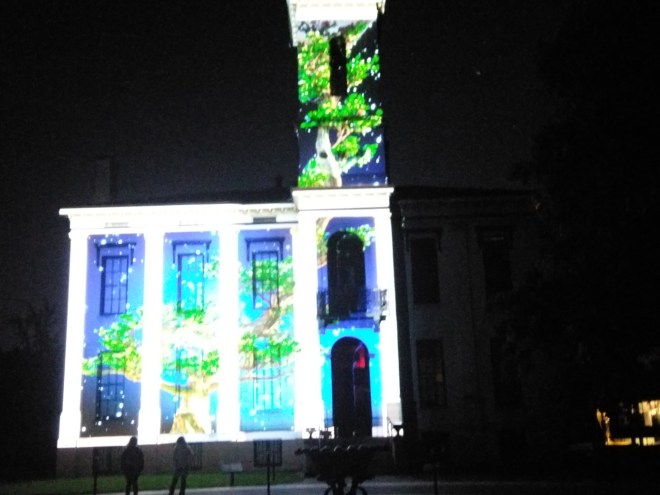
We also did the St. Louis Botanical Garden a couple times; once for a walk and another time to see their fall light show. If you like playing around with form and light the Botanical Garden has plenty of photographic possibilities. I could spend a lot of time there.

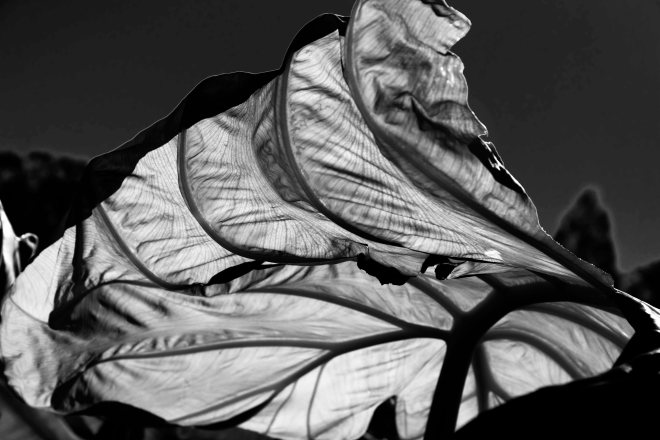
_DSC1579Wilted lotus leaf.

_DSC1582

_DSC1583Lise messing with me when I’m trying to take pictures of lotus leaves.

IMAG0115

IMAG0106

IMAG0121

Some cell phone light show pictures. The light show was not at all what I expected. I was thinking Christmas lights wrapped around trees. They did some spectacular laser shows  and I wished I had brought by regular camera.

In the “living on past glory” category, we have Wingate Indiana. On the way between West Lafayette and St. Louis we drove through Wingate. I always knew basketball is a big Indiana thing. Think the movie Hoosiers, based on the story of Milan, Indiana. Think Larry Byrd and dozens of other Indiana basketball stories. Then there’s the storied past of Wingate. State basketball champions not once, but twice. Over a hundred years ago. Before WW I. Forty years before Milan won the State championship. First electronic scoreboard too, probably right after the invention of electricity. Do I see another movie possibility here?

IMAG0123Ya gotta go with what ya got.


Friday, October 19, 2018

We are in West Lafayette for the night. Lise had a work-related trip down here so we decided to make a road trip out of it. From here we go to St Louis for a couple days to see baby Ava. We want to see Stefan and Kasey too, but they’re not cute little babies that are growing fast. Baby Ava is.

I’ve been having a hard time getting blog posts up. Partly a time issue. I was asked to help someone with the MSU course he is teaching. So, I’ve done a couple classes for him, as well as the two classes I teach at LCC. I’ve also been doing GIS work for some civil engineers, helping with a non-profit land conservancy, trying to work out on a regular basis, playing a wee bit in the workshop, and working on the house. Nothing particularly exciting.

There’s some element on writer’s block involved too. I’m just having a hard time getting an interesting story from the rather mundane things eating up our time lately. A good photographer can take a great photo of a mundane subject. A good writer should be able to make a mundane subject interesting. I just can’t see how to make painting a bedroom interesting. Especially when you use the bland, make the house saleable, neutral colors we’re using. Tiger striped walls would be interesting. “Autumn Dawn” is not.

Things are happening in the natural world. Up in Michigan we’ve made the transition to oncoming winter. A couple day’s ago there was still the hope of an afternoon warm enough to enjoy outside gin and tonic while letting the lizard romp in the yard. The lizard still wants to go outside but sitting in 45-degree temperatures just isn’t gin and tonic weather. Gin and tonics are made for lazy warm afternoons. Might be time t switch to hot buttered rum.

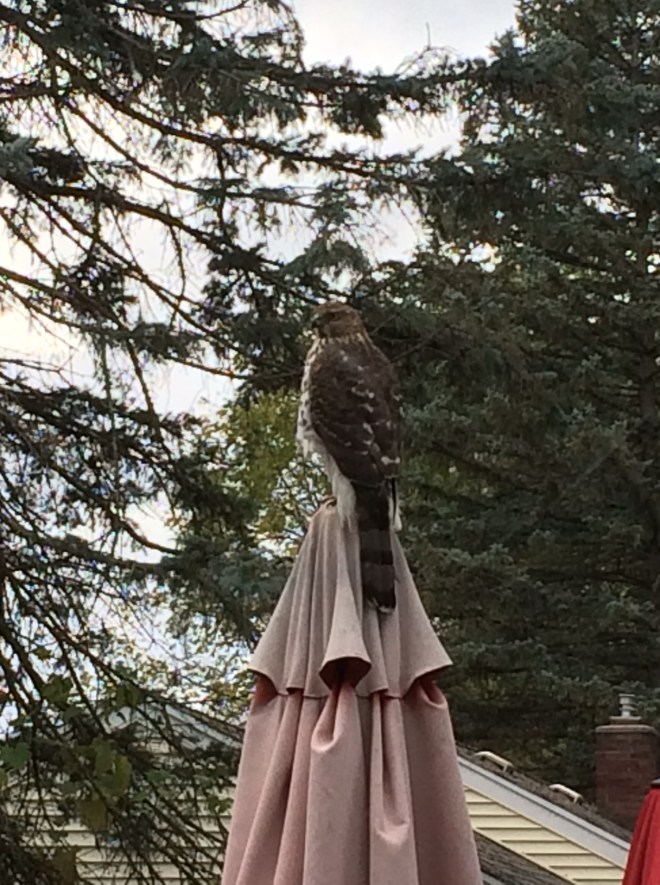
Along with the changing seasons comes changing wildlife. The summer residents have migrated out and yesterday we saw our first junco of the season at our feeders. Raptor migration is in full swing. The Detroit River hawk watch has been getting daily counts of migrating raptors in the 5,000 range. Yesterday we had an immature Cooper’s hawk sitting on our back porch, terrorizing the local feeder birds. I’m pretty sure this guy was just passing through. The resident hawks know the better places to nail a meal.

IMG_1364

Cooper’s hawk scoping out our feeders. Lise cell phone picture.

Sunday, October 7, 2018

Our theme song should Willie Nelson’s “On the Road Again”. We have been on the road, all family-based travel and good.

We were in West Lafayette September 29 – Oct 1 for the ever-adorable baby Ava’s baptism. Lise and I had the honor of being named Ava’s godparents. Not sure what all that entails but I think it’s my responsibility to teach her how to play blackjack. Hit on 16, pat on 17. I think that’s one of the ten commandments. A ceremony like a baptism should be a family event and this was no exception. Clan Eichhorn was pretty well represented at the ceremony. Always good to see family.

happy familyStefan, Kasey, and Ava, post baptism.

IMG_1319Waiting for the Mexican take-out order.

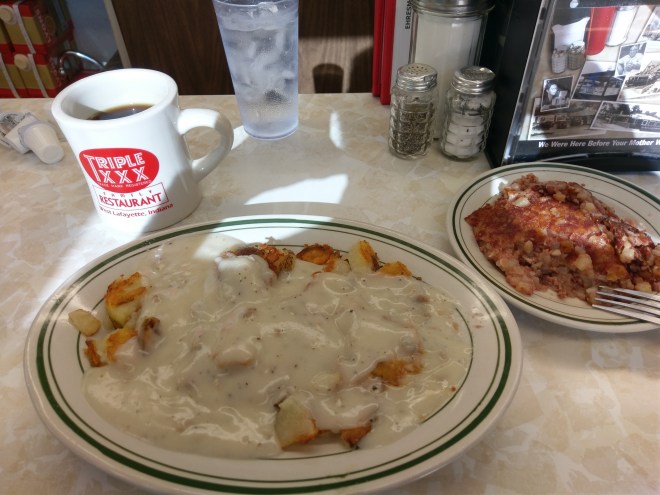
West Lafayette isn’t exactly what I would call an exciting place, but we did have some fun. An artery clogging breakfast at the XXX diner is a must. And I got my barred owl for the year, while walking through Happy Hollow Park.

IMAG0087All that’s missing is scrapple.

This past Friday, we drove to Milwaukee for my niece Teresa’s wedding to her long-time partner Chris. They’re about 30 years old and have been dating since high school. For his toast my brother Rich’s main comment was, “don’t make us wait this long for grandkids.”

This was another good family trip. All my siblings showed up, something that doesn’t happen too often. Throw in a bunch of nieces and nephews and you have the makings of a family reunion.

IMG_1325Niece Katie, and her daughter Charlee , down from the Aleutian Islands.

IMAG0089Anita, in from PA, with nephew Zack, and his daughter Stella in from Chicago.

Saying Milwaukee is a beer town is something of an understatement. This is the ancestral home of Pabst Blue Ribbon, Dad’s go to beer later in life. So, we all went to the Pabst Tap Room to have one for Dad.

In the Pabst Tap Room, where they have an Olympic grade beer pong table.

My only prior experience with Milwaukee was driving by on the Interstate. It’s a pretty neat place. Milwaukee looks like one of those cities that had seen better days but is now undergoing a renaissance. There’s some interesting architecture, and a lot going on. Shame we had to leave on Saturday, without much time to explore.

The Pabst brewery, built like a castle.

IMAG0093

Entrance to the Milwaukee Art Museum, on the shores of Lake Michigan.

In the “you can’t be serious category”, this is Belle, our friend’s new dog. A Great Pyrenees Mountain Dog puppy. A puppy mind you. Look at those feet. This beast will be using a VW bug as a chew toy.

IMAG0086

Saturday, September 22, 2018

This will be the last of the cutting board chronicles.

Up to this point I got the center of the cutting board constructed. Once the center of the cutting board was assembled, I added a few alternating colored wood strips along the long edges of the board. Making the edge strips entailed the same process of milling, cutting and gluing as used to make the center of the cutting board.

Not every board is exactly the same size, and during the gluing process the boards can slip a little. The end result is that the cutting board faces are not perfectly smooth. So, once everything was glued, and the glue had sufficient time to dry, the cutting board faces had to be planed smooth. I had to use the same process as planing the rough lumber. One face was laid down on the planing sled and shimmed up, allowing the other face to be planed smooth. Once one face is planed smooth, the piece is flipped and the second face planed.

_DSC1504All glued and planed.

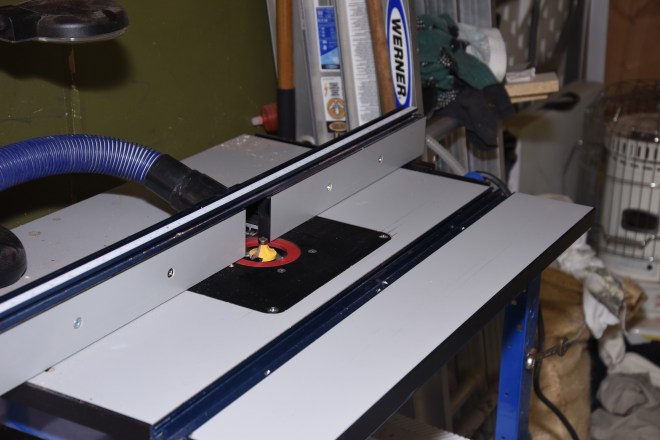
At this stage, the cutting board has hard edges and corners. Perfectly usable but not aesthetically pleasing. Casting off my engineering background I wanted to add some aesthetic touches by rounding down the edges to soften them. This is the job of a router with a round-over bit. For those unfamiliar with a router, it is a tool that rapidly spins a sharp, shaped bit. By contacting the wood, the bit pattern is transferred to the wood. My router is mounted on a table giving a stable work platform. The router spins at several thousand rounds per minute, making it a potentially dangerous tool. You do not want to get your fingers in contact with a spinning router bit. Blood on the bit can cause some major corrosion and someone has to clean the blood off the wall. Plus, the loss of a couple fingers can really mess up an otherwise perfectly nice day. Makes it hard to flip off tRump.

_DSC1532Round over router bit.

_DSC1537

My router table. The router is mounted under the table and the bit sticks up through the surface.

The round-over bit I’m using has a bearing at the top to guide the workpiece and ensure an even cut. One can freehand route like this, but I try to use a fence whenever possible. Especially for routing across the grain of the board. Going across the grain can create what is called chip-out on the corners. To prevent chip-out, I use a piece of scrap wood between the side of the cutting board and the fence.

A router is an unforgiving tool and it is easy to butcher an almost finished project if you aren’t careful. A smart operator does each router cut in small increments, producing shallow, controllable cuts. The result is a pleasing, rounded edge. A similar process can be used to put in juice grooves on the top face and cutouts on the bottom to help when handling the board. Lindsay wanted a rounded edge on both faces which allows both faces to be used for cutting.

_DSC1542Routing using a table saw crosscut fence with a backing board.

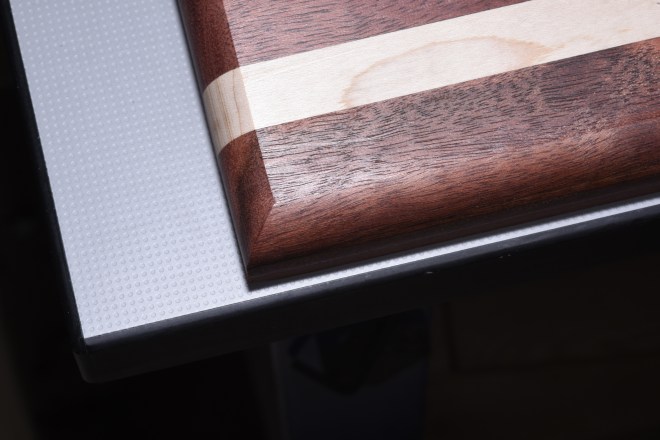
_DSC1528Aesthetically pleasing, nicely rounded edges.

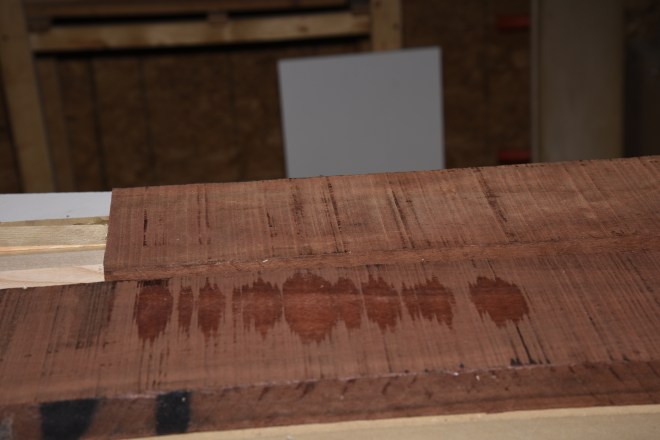
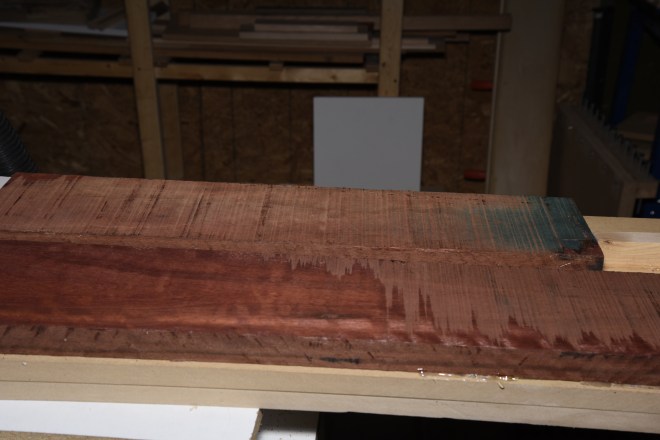
After routing it’s on to the finish sanding. The board is completely sanded with a succession of sandpaper grits going from the coarsest to the finest. With good sanding you can get an almost glass-like surface on the cutting board. Unfortunately, at this point that glass-like finish doesn’t remain when a finish is applied. Sanding cuts off the ends of wood fibers. A liquid finish will make the cut off wood fiber ends swell, turning your glass-like surface rough again. So before applying a finish the board wetted with water. The water swells the wood fiber ends and they can be sanded off, using a light touch with a very fine grit sandpaper. This process is repeated a couple times to make sure the board is a smooth as it can be.

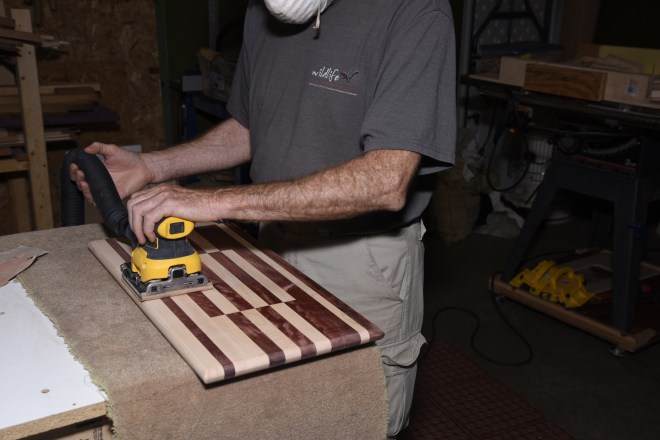
_DSC1550Initial finish sanding with a sander

_DSC1561Wetting down the board.

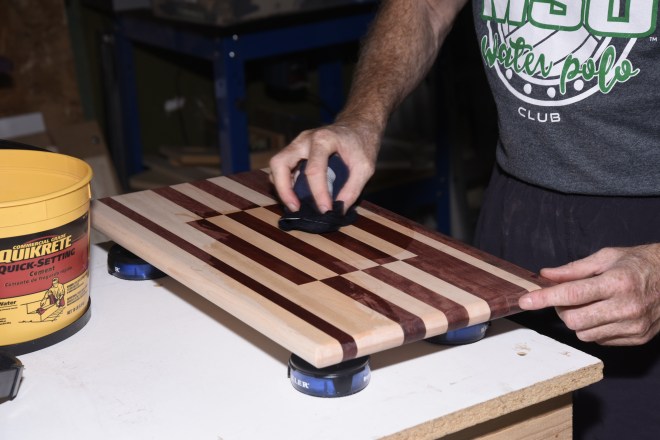
_DSC1557Finer sanding with a block.

Now it’s on to the final stage, applying the finish. I use mineral oil to finish cutting boards. The goal is to saturate the wood with the mineral oil, so it takes a number of coats. After the first coat or two of oil, I do another very light sanding with a very fine grit sandpaper. The oil darkens the wood, but really makes the grain pattern pop out.

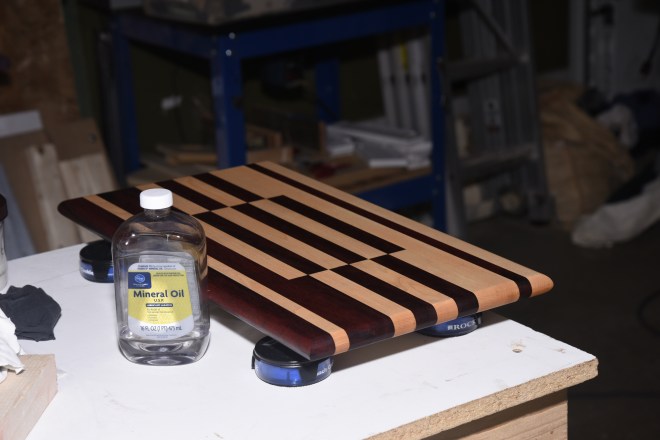
_DSC1562After a couple coats of mineral oil.

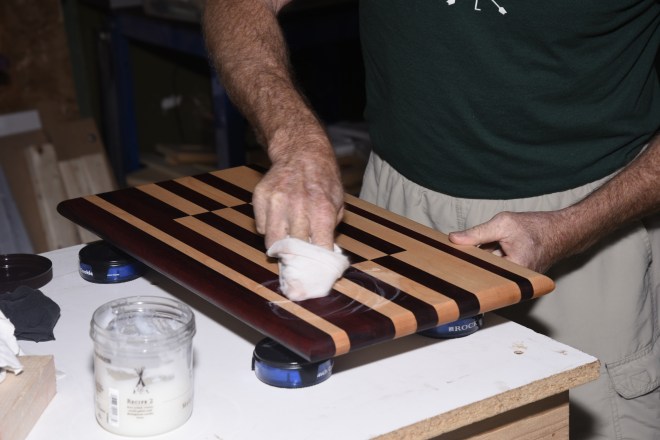
The final coat is a layer of mineral oil mixed with bee’s wax. It’s a homemade mixture made by melting 10 rounded teaspoons of bee’s wax in six ounces of mineral oil. I didn’t come up with the mixture, I got it from a YouTube video. The mixture cools to a paste that is rubbed onto the cutting board and can be buffed to a satin shine.

_DSC1564Applying the final coat.

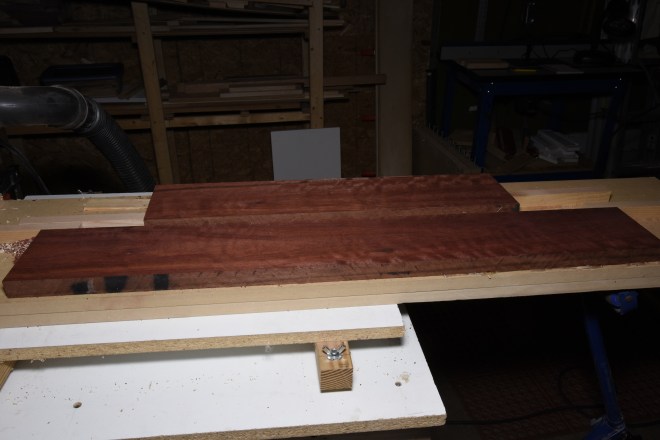
So the process takes us from rough-sawn lumber like this:

_DSC1172Rough-sawn lumber

To this:

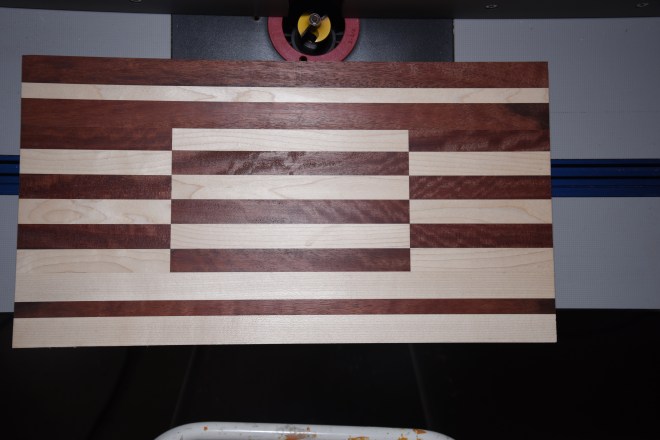
_DSC1570Lindsay’s cutting board.

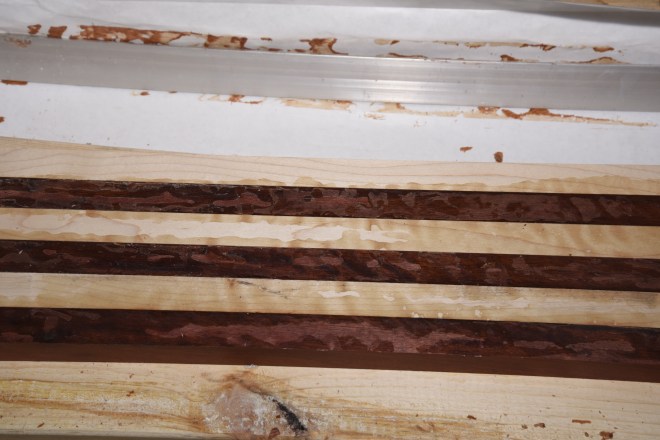
This cutting board is about 12” X 22” and made from bloodwood and hard maple. I’ll also be making Lindsay a couple smaller boards to go along with this one as a set. This process and the techniques I used are basically the same for any project. Naturally there are variables like; complexity of the project, how much rough-cut lumber processing needs to be done, complex angle cutting, types of finishes, etc. Making a basic cutting board is a straightforward process. Except for glue drying time, one could knock out something similar in a couple hours, with the proper tools and a well set up shop. For a weekend warrior like me, still learning and working around tool and space issues, it takes a bit longer. But I would say it’s time well spent.


September 17, 2018

As usual I’m a little behind on things. Lise and I did a little mini-vacation and met our friend Joanna at Limberlost Lodge, in Ontario Canada. Unfortunately, the rest of the world doesn’t stop just because we took a little break.

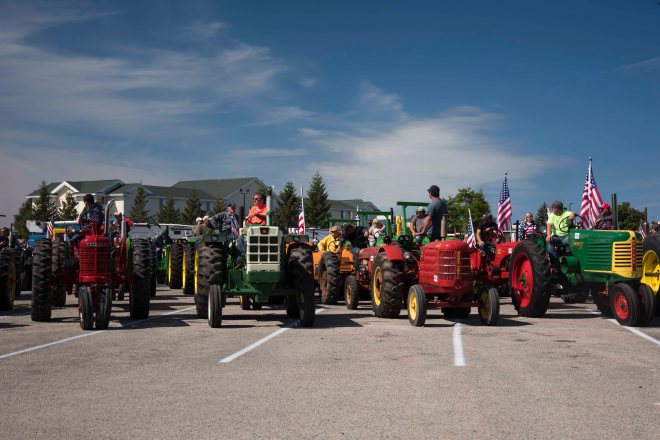
In the everyone needs a hobby category, how about antique tractors. On the way Canada, we stopped in Mackinac City for lunch at the Mackinac Bridge. Rolling off I-75 off into town we saw a street blocked off for a parade. Couldn’t think of any holidays so I jokingly said, “probably just a couple tractors someone wants to show off.” I was a little wrong. It was the annual Mackinaw Bridge Antique Tractor Crossing and Show with over 1300 antique tractors. The Grand Prix of the antique tractor world.  I spent literally about 30 seconds too long in the Starbucks and we got trapped in their midst. Antique tractors do not move fast. Good thing we weren’t in a hurry because there was nothing we could do but sit back and watch the parade.

tractorsGentlemen, start your engines!

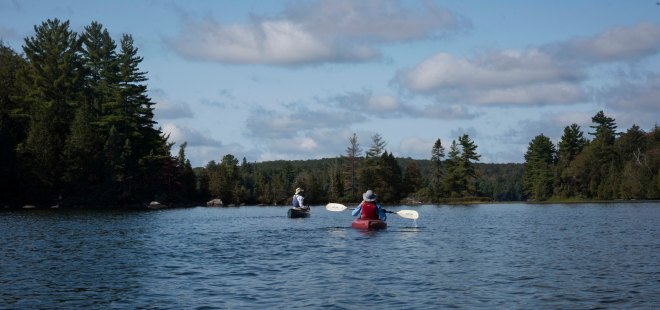
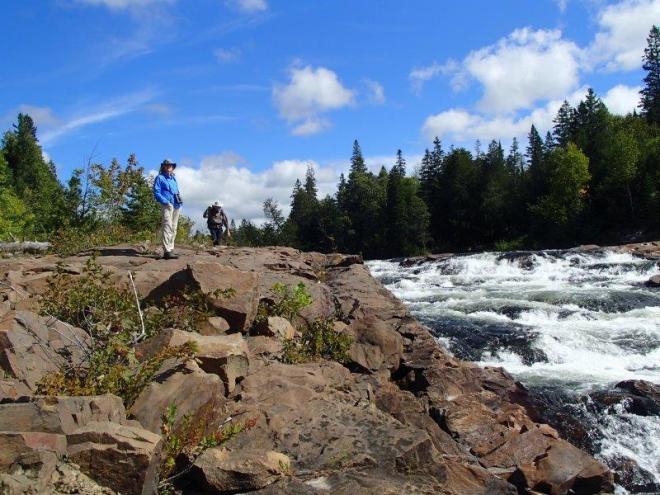
It was a nice relaxing trip. Limberlost Lodge is about 25 miles (40 km) north of Thessalon, Ontario. Really nice country. Lots of lakes, lots of rivers, and lots of open spaces. Once you head north from Lake Huron, population drops off noticeably. We did a little birding, a little kayaking, some hiking, a bit of photography, and just general idling about. What a vacation should be all about.

P9110014Lise kayaking. Joanna Mitchell picture.

kayakingLise and Joanna kayaking.

P9090004Drinking wine from a water glass, contemplating buying an antique tractor. Joanna Mitchell picture.

P9100005At Bell Falls. Joanna Mitchell picture.

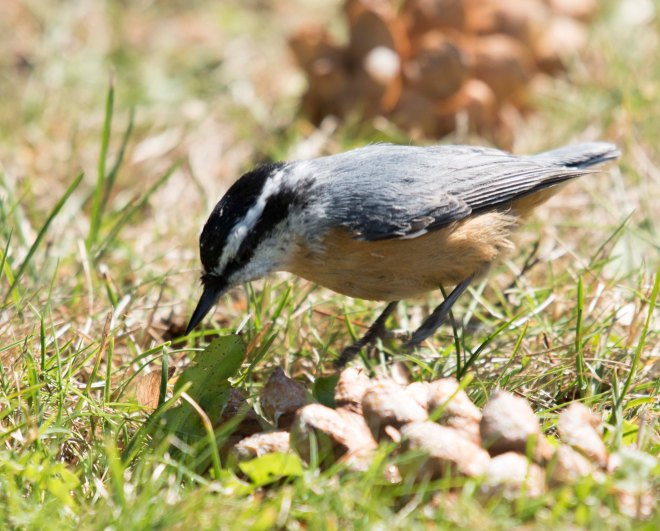
RBNHRed-breasted nuthatch.

P9030022

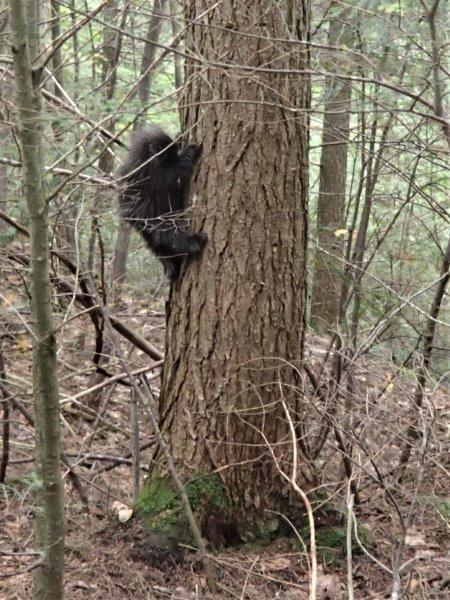
Porcupine. Joanna Mitchell picture.

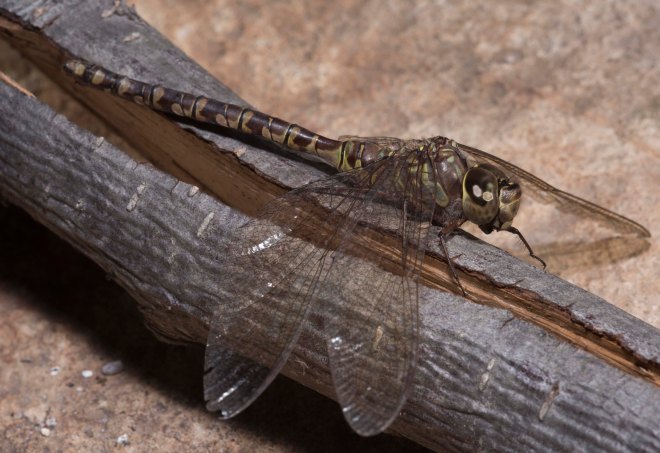
canada darnerThe aptly named Canada Darner.

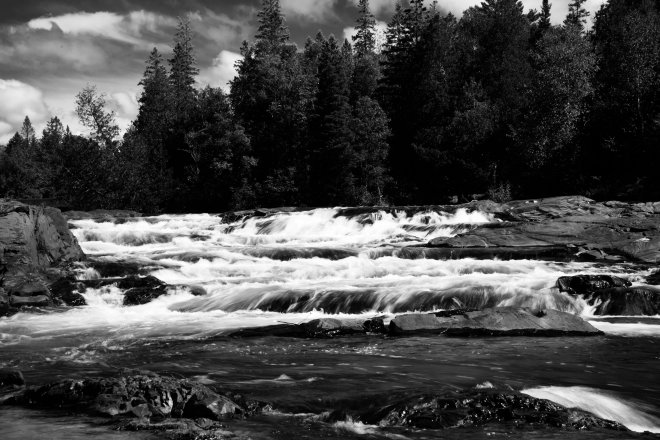
Bell FallsBell Falls.

wetlandWetland near Limberlost.

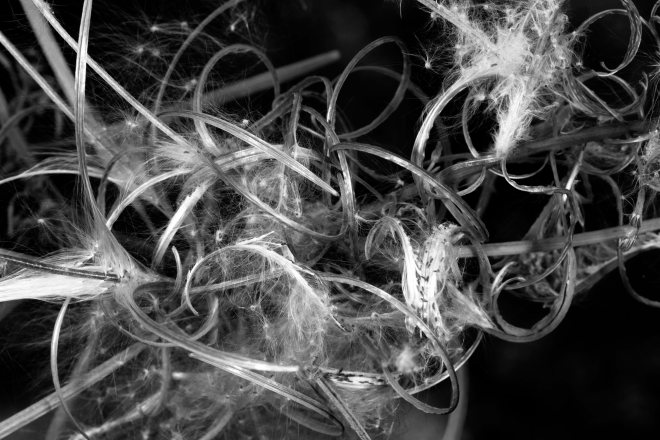
seedhead1

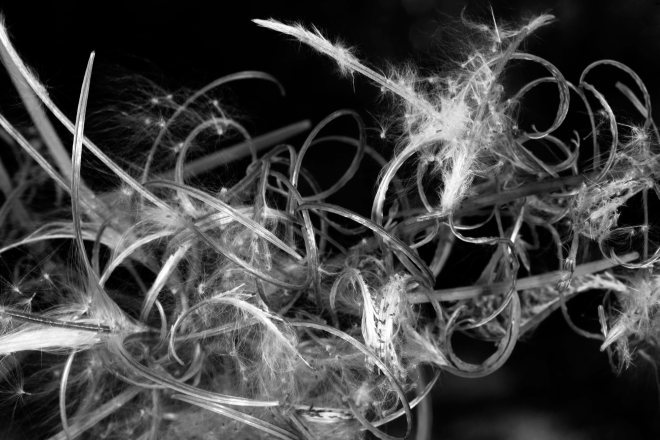
seedhead2

seedhead3Curly, spiraling seed heads. OK, I liked these guys.

smartweedSmartweed.

So, now we’re back in tRump land, playing catch-up. I have to say, it was nice to be a bit disconnected, not hearing the latest idiocy from the Nut Case in Chief. All good things must come to an end I guess.


Wednesday, September 5, 2018

It has been a shop kind of week for me. I’ve spent the past week diligently working on Lindsay’s cutting boards and milling lumber for others. So it’s time to continue my little essay on woodworking.

Once we have our rough lumber milled flat and smooth on both faces and a good edge it’s time to cut the boards into strips. This is done on the table saw, using a table saw fence as a guide. The objective is to keep the flat reference edge of the board against the fence. The fence is locked into place, so the space between the fence and the blade remains the same, ensuring equal sized strips.

Cutting these long strips with the grain is called ripping a board. The saw blade is raised just enough to clear the board, in order to minimize damage to one’s fingers should there be an accident. There is a hazard associated with table saws called kickback. When ripping, kickback can occur when the cut portion of the board behind the blade closes together and pinches the blade. Kick back can be pretty nasty. In addition to a board flying back towards you at high speed, your hand can get dragged across the spinning blade. My saw is missing the equipment to help prevent the kickback so I take extra care when cutting. With really long boards I have Lise putting wedges into the cut as it passes the edge of the table, just to make sure the board can’t pinch on the blade.

_DSC1236

_DSC1237

_DSC1238Ripping boards into strips.

Once the strips are all cut it is on to the messy business of gluing. This is not my favorite part of the process. The wood glue is very strong and sets quickly. Ideally both surfaces to joined together will be completely covered with a layer of glue and then quickly pressed and clamped together. Hopefully without sliding out of place or bucking up. I’m using a gluing jig I built that allows me to glue up multiple strips, then quickly put a large amount of equal pressure on all of them. The jig is a lot easier than using a bunch of clamps as I used to do. Once the pressure is applied, glue is squeezed out along the seams in the strips. This is a good sign because it tells you that the glue is spread completely and evenly along the glued surfaces. It does make a mess that later has to be cleaned off by sanding or using the planer.

_DSC1242Gluing jig.

Glue squeeze out.

_DSC1252Dried glue that needs to cleaned off.

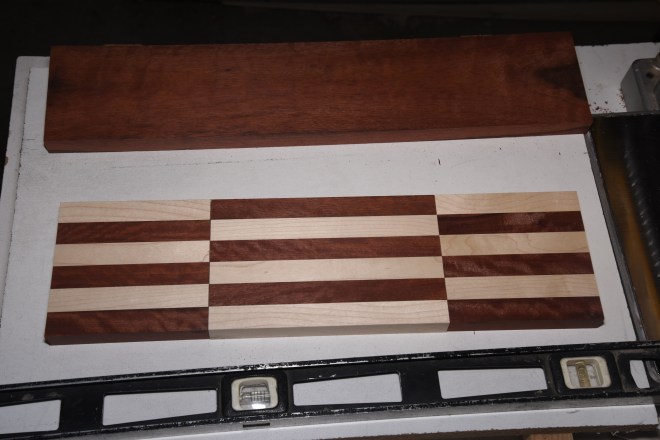
This cutting board isn’t going to be just a bunch of strips glued together. These six strips are about six inches wide in total and will be the center of a board approximately twelve inches wide. To make the center stand out I’m going to use a checker board pattern. To make a checker board pattern the glued board is crosscut into three pieces and the center piece flipped over. I do the crosscutting with a sled I built for the table saw. The piece I’m cutting sits in the sled and stays stationary while the sled slides across the table. When the sled is set up right it is easy to get a square cut and it’s a lot safer.

Crosscutting sled.

_DSC1259Center piece flipped over.

These three pieces have to be glued together but the process is a bit different than gluing strips together. Wood is essentially a bundle of fibers. When gluing on the long side of the fibers, as in gluing two strips side by side together, the glue penetrates the fibers on both surfaces and bonds them together. The glue is actually stronger than the wood. When a glues joint fails it is because the wood breaks, not the glue failing.

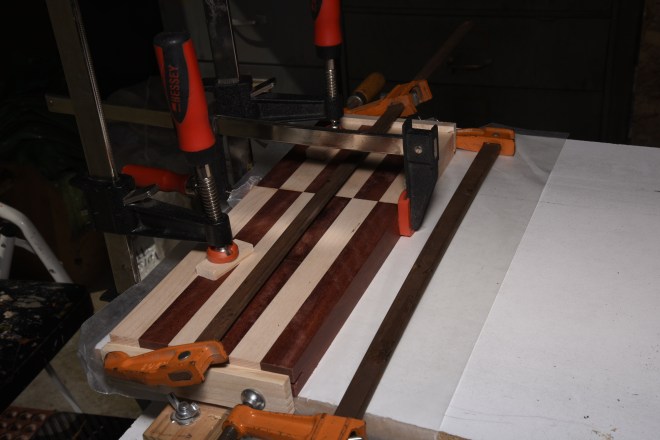
With these crosscut pieces, the ends that need to be joined together are called end grain. It’s the end of the wood fibers, not the sides of the fibers. With minimal surface area to join together the joint is weak. Think of gluing two straws together, end to end. To give the joint strength I use something called a spline joint. The two ends are slotted using the table saw, and a spline, a piece of wood the same thickness of the saw blade, is used to join them. The inside of the slots and the spline are side grain, allowing the glue to make a strong bond.

_DSC1269Cutting a slot.

The slot and the spline.

_DSC1294Gluing the pieces together.

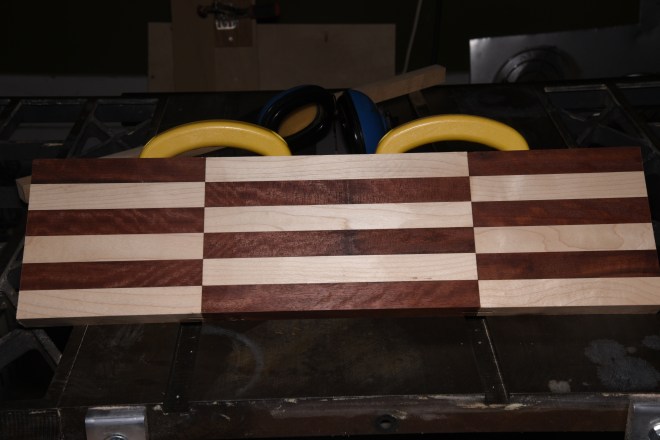
With all three pieces are glued together I now have the “checker board” pattern that will be the center of the cutting board. The next steps are cutting and gluing the strips for the outside edges, cleaning everything up, rounding over edges with a router, maybe putting in juice grooves, sanding, and finishing. So, to be continued…..

_DSC1301The center of the cutting board, approximately 22 inches long and 6 inches wide. More to come.

We have gotten in some outdoor play time too. Last Friday Lise and I went down to Pte. Mouillee to catch some shorebird migration. We got several new birds for the year, most notably a Baird’s sandpiper that we keyed out all by ourselves. No easy task I might add. Baird’s is one of the peep sandpipers where minor differences in the shape of a bill or the length of the wings differentiate species. It did help that we knew there were Baird’s in the area. Still, we felt pretty good about it. Lise is at 235 species for the year and I am at 233.

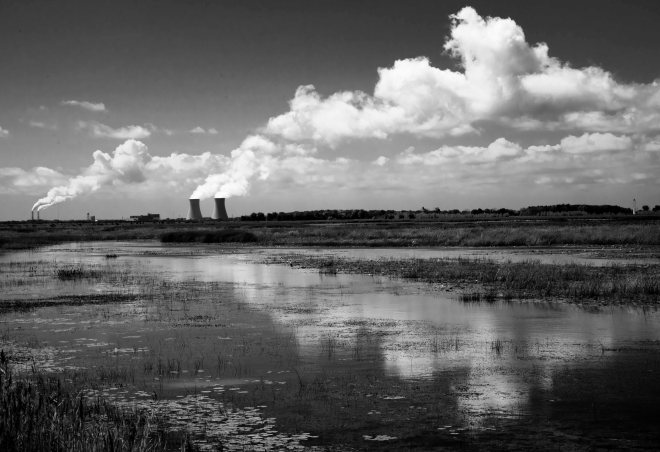
point mooPte. Moo, downstream from the Fermi nuclear plant.


Tuesday, August 28, 2018

I’ve been pretty busy lately, not a small part of which is doing some wood working. This is something I enjoy as much as photography. I get a deep pleasure taking rough lumber and making something nice and usable from it. I thought I would run through the process of going from rough lumber to a finished product. In this case a cutting board set I am doing for Lindsay. The pictures in this process are using bloodwood, from Central and South America. Videos would be a much better presentation but I’m not very adept at making them. Just getting pictures took long enough.

The process starts with milling rough cut lumber into something flat with a square edge for a cutting reference. I use rough cut lumber because it is a lot less expensive than finished boards. Rough cut means just that. It isn’t planed smooth and doesn’t have a finished edge. It usually has some warp and twist to it also. It isn’t the safest thing to cut because it can twist in the saw and move unpredictably.

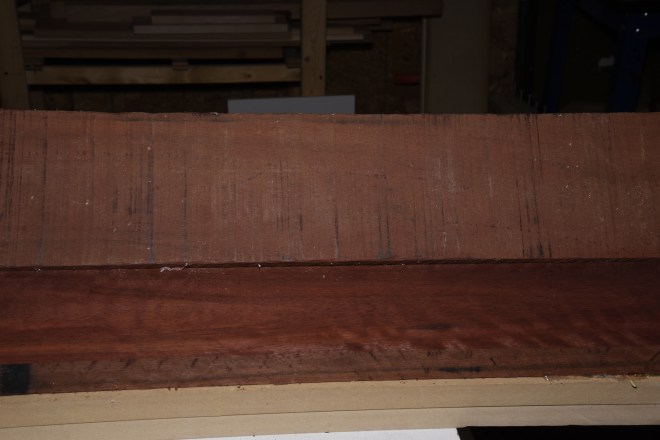
_DSC1162Full length board showing warp.

_DSC1172Close up showing the amount of warp with the rough sides and edges.

The first task is to cut boards that may range from six to ten feet long into something manageable. Cross-cutting on the table saw would work, but I think using the miter saw (or chop saw) is easier and safer. The miter saw bed is short, so the boards need to be supported. The end result is a stack of boards that now need to be planed to provide flat surfaces.
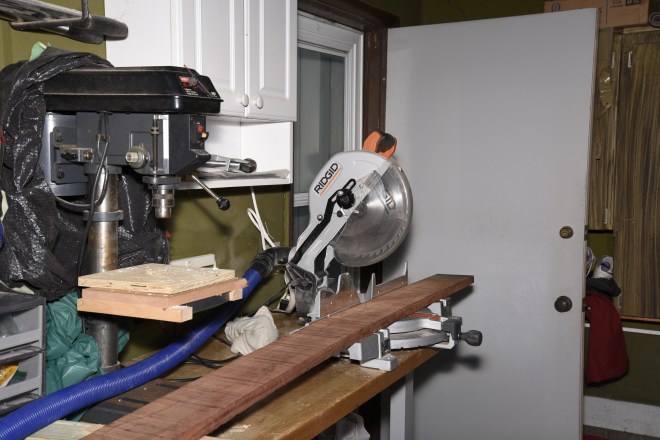
_DSC1178Full length board on the saw. The long blue hose connects to a shop vac.
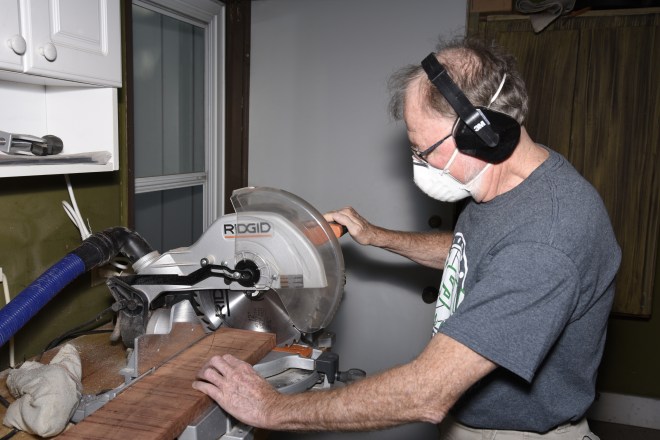
_DSC1183Cutting the boards. Notice the appropriate safety gear.
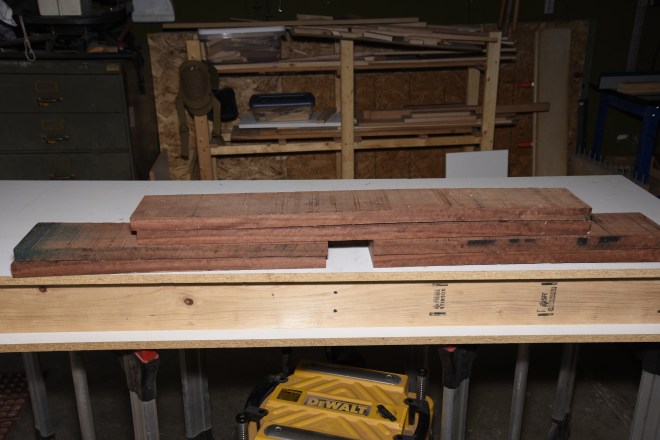
_DSC1184The end result, a pile of rough finished boards ready for the next step.

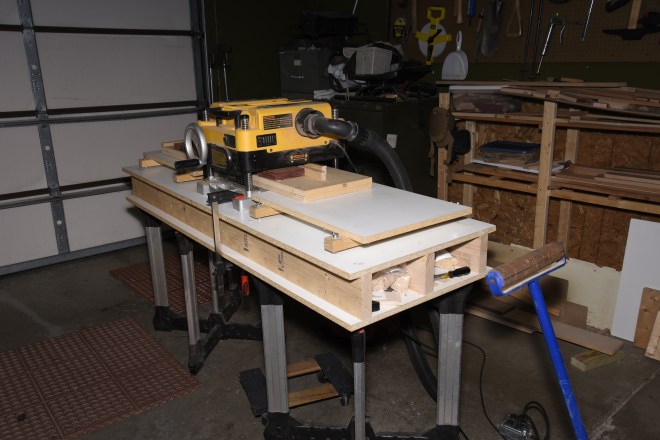
I have to do planing with a surface, or parallel, planer. A larger shop would use a jointer for this purpose. Since I don’t have the room, or money, for a jointer, I use the planer. One can’t just run the rough boards through the planer. A parallel planer does just that, it makes the two sides of the board parallel to each other. The bottom side serves as a reference and the planer smooths the top side of the board. Without having a flat smooth reference side, any deformity like a twist or warp in the wood is transferred to the top side. You end up with a board that has smooth, twisted sides. Not very usable.

The way around this is to use a planer sled. A planer sled is simply a flat piece of material, in my case a man-made product called MDF. You place your board on the sled, and glue wedges in the gaps between the board and the sled. The wedges steady the board as you plane it, so you will get a smooth surface without any twists or warps. Sacrifice boards at the beginning and end of the boards prevent what is called planer snipe. This is where the planer cutters first gouge into the wood. The snipe ends up in the sacrifice boards, not your production boards.

Wedges glued between the board and the sled.
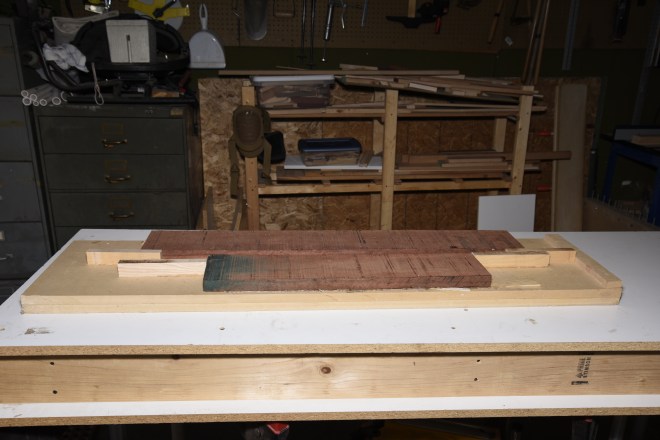
_DSC1189Sled with two wedged up boards. My sled is 1.5 inch MDF. It gets pretty heavy when loaded with a dense wood like bloodwood.

Once set up, the sled is run through the planer. Each pass through the planer will trim off the highest areas of the board. I typically trim something like 1/32” to 1.64” on each pass. Deeper cuts are possible, but I run right at the limit of what my circuit breakers can handle. Deeper cuts can cause the planer to draw too much current and trip a breaker. This causes a gouge in the wood where the cutters stop and a lot of swearing on my part. I don’t have a shot at heaven as long as I’m woodworking. Eventually, after a lot of passes, I have boards with one smooth flat surface.
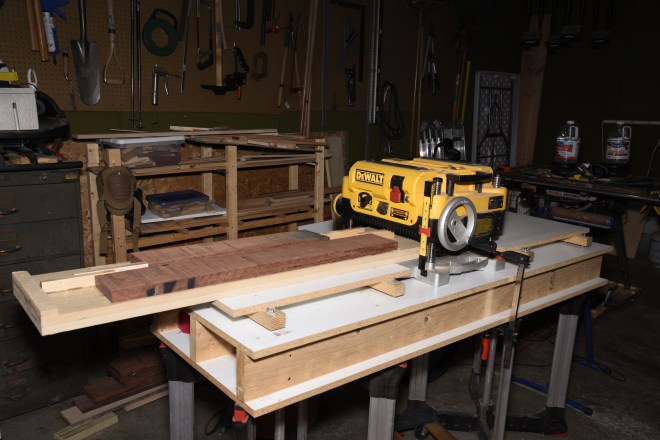
_DSC1192Sled on the planer.

_DSC1194Sled coming through the planer.

_DSC1196

_DSC1197Smoothing on successive passes.

_DSC1203Finished smooth boards.

_DSC1205Smooth board and rough board for comparison.

The smooth flat side of the board now provides a good reference for planing the other side of the boards, without using the sled. Sacrifice boards are still required to eliminate snipe. When planing multiple boards there is a certain amount of juggling to keep a steady flow going through the planer. On this run I had three shorter boards (two feet long) and two longer boards (three feet long). Lise helped to keep the outfeed boards from falling to the floor.

_DSC1212Planning the second side of the boards.

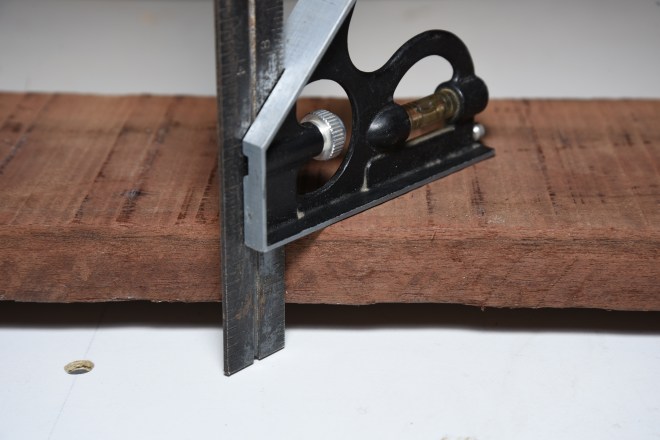
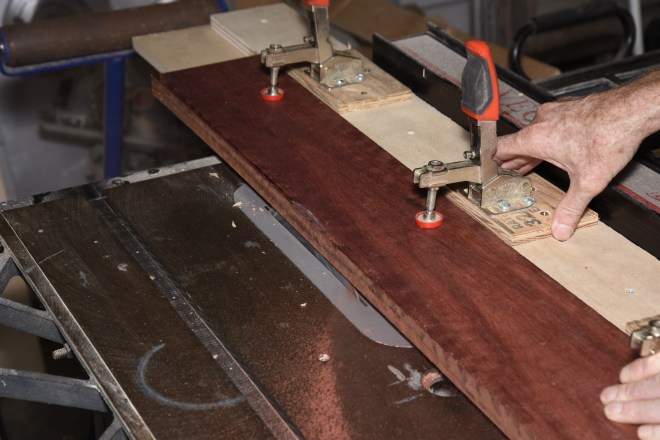
Once the boards have been planed and flattened on both sides, I still need to get a straight edge perpendicular to the planed sides. This will give a reference edge for cutting the boards down to the needed size. To get a straight edge I use a jig I made. It has a straight reference side, and clamps to hold a board in place. When a board is clamped in the jig, the reference side of the jig is braced against the table saw fence, and a strip cut off the board. This process produces boards that are flat on two sides, and have clean edge, square to the board surfaces.
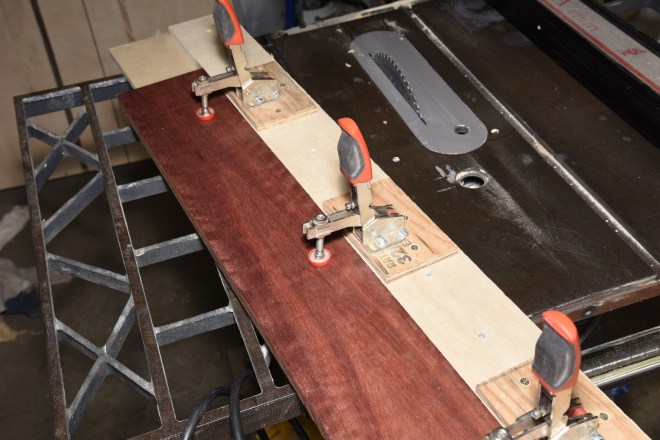
_DSC1216Board clamped into jig.

_DSC1219Running the board and jig through the table saw to produce a clean edge, square to the surface. That spinning blade is not something to be trifled with. A mistake here can make counting to five on one hand difficult if not impossible.
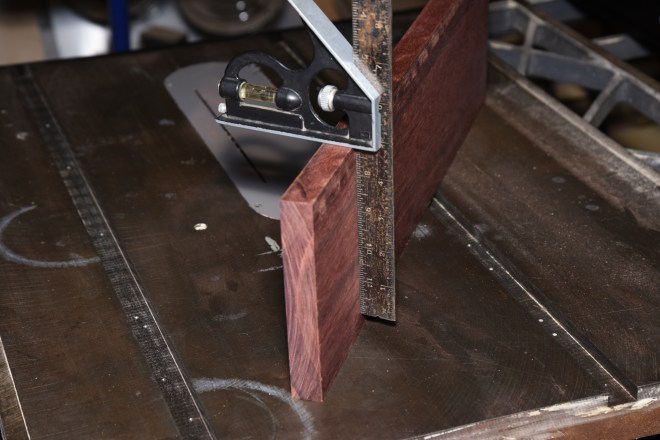
_DSC1222Finished board. Two flat parallel sides and a smooth edge square to the sides for a cutting reference.

_DSC1223Comparison of finished board and an unprocessed board.

I now have the bloodwood milled. I have to repeat the process for all the wood I’m using. In this case hard maple, plus maybe some cherry, black walnut, and purple heart. After milling we get into the cutting, gluing, smoothing, routing, sanding, and finishing. Fun stuff and the subject of the next post or two.


Wednesday, August 15, 2018

We are back in Okemos after our second trip to Pennsylvania and Philly in a month. An event I expect to see repeated over the coming years. It now feels like we have officially launched Molly. We took van and a 10-foot trailer, both fully loaded with Molly’s stuff. And we took Lindsay too, but we brought her back.

IMAG0056[1]Lindsay helping pack.

IMAG0057[1]Loaded and ready to roll.

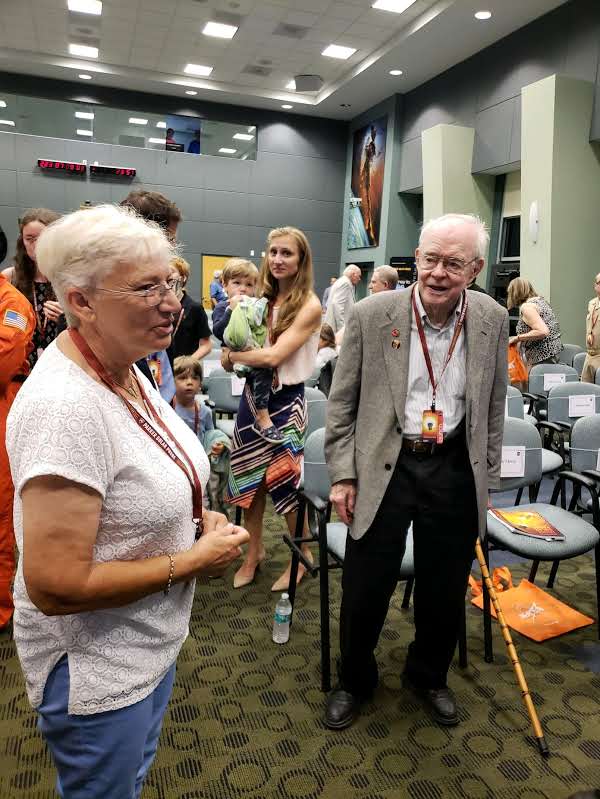
So, while I was traversing the PA Turnpike, my siblings were in Florida viewing the launch of the Parker Solar probe. From the NASA VIP lounge no less. Where they got to meet Eugene Parker, the physicist the probe was named after. Too cool. Good connections pay off. The most exciting thing that I, the only person in my family with a physics degree, got to see was a rear-end accident on the PA Turnpike. I’m only a little jealous.

1222

Lynn and Gene Parker.

42184535980_7c12d2235e_kWhat they got to see (NASA photo).

IMAG0065[1]What I stared at all day.

IMAG0062[1]This was a little scary. Guess they ave to learn somewhere.

With Molly officially gone I spent a half day taking apart her Ikea bunkbed. The trick was taking it apart in a such a way that it can be reassembled. Lesson learned, Ikea furniture is made to go together, not be taken apart. I have some saws and torches that would have made the taking apart easy, but the reassemble part would have been another story. I eventually got it apart, but it wasn’t fun. I guess it could have been worse. I’m sure there’s things equally horrifying. A tRump second term, a Pence presidency, or having your cellmate Bubba give you a Valentine’s Day card come right to mind.

I also got out today to do some odonating. Only the second time this summer. I was realy out of practice but managed to get a couple photos of the regulars.

green darnerFemale common green darner.

violet dancerViolet dancer.

calico pennantCalico pennant.

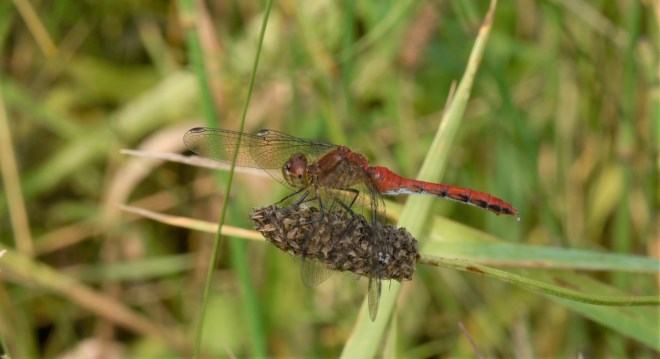
meadowhawkOne of the meadowhawks, probably red-faced.
Tuesday, July 31,

Well as if we couldn’t get enough traveling in, we took a little trip to Pennsylvania. Dual purpose; I had a family reunion and we visited Molly in Philadelphia.

Not much to say about the family reunion. Reunions are reunions.

We spent a night with Molly and Mitchell in Philly. This isn’t the Philly I remember as a kid. We did regular school trips to Philly for things like the Franklin Institute and Independence Hall. Or the occasional family trip to the Philly Zoo. Back then it was not a place you wanted to spend a lot of time in, let alone live there. Things have changed there and for the better.

Philly is one of those old metropolitan areas that have seen a renaissance. Molly lives in the downtown area, in a neighborhood full of restaurants, coffeeshops, bars, and stores. All within close walking distance. If you don’t want to get your produce from a grocery store there’s the Italian Market or the Reading Terminal market, both in operation since the 1800s.

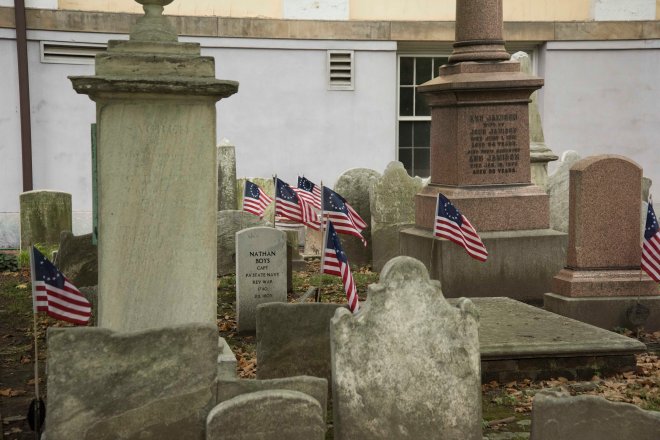
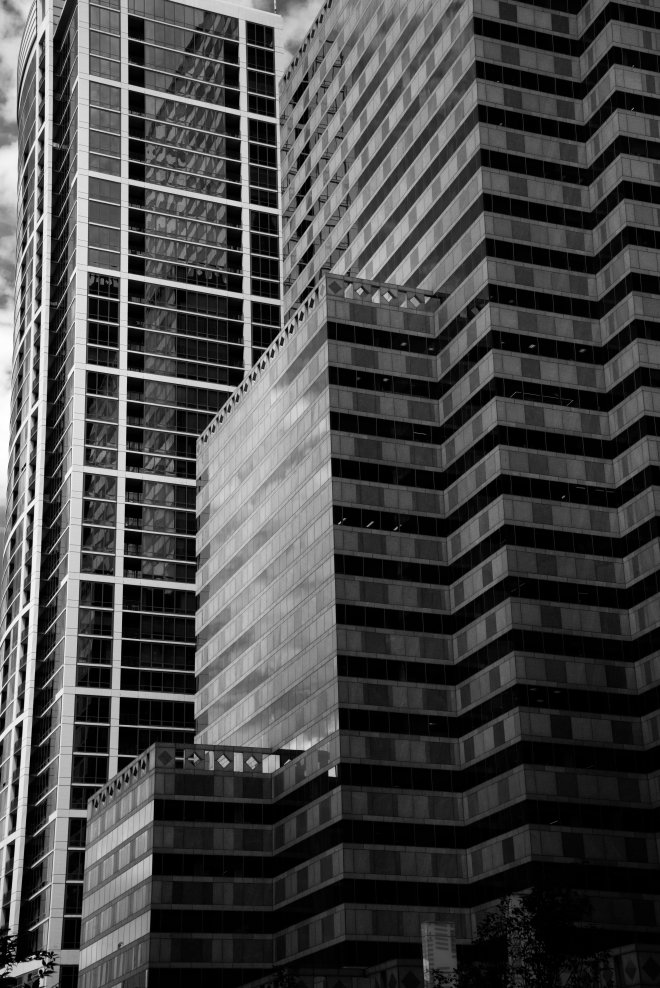
Philly is a juxtaposition of old and new. William Penn founded the city in 1682. It has modern glass and steel sky scrapers, but it also has buildings from before the revolutionary war. Some of the buildings, like Independence Hall and Carpenters Hall, were important in the revolution. If you are interested in early American history, Philly is one of the places to be.

_DSC1075

_DSC1074Philly skyscrapers.

graves2

graves1The graves of Revolutionary War soldiers and sailors.
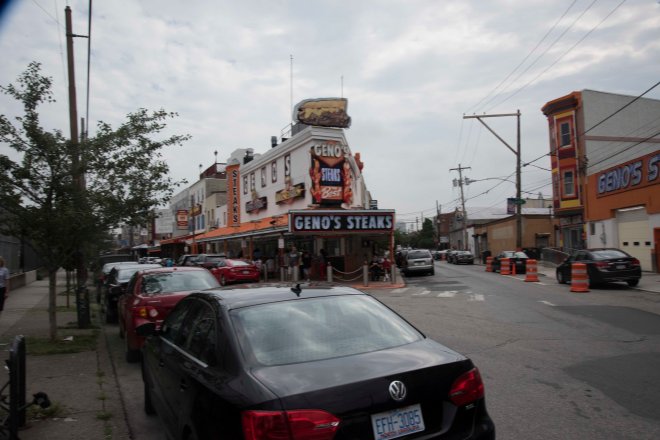
Life in Philly seems to revolve around eating and drinking. Great eating, but the kind of eating that tends to line the aorta with nasty stuff. I don’t think a vegetarian could survive in Philly. Probably starve to death. Just a little south of the Italian Market are the purported two best Philly cheese steak restaurants in Philly. Across the street from each other. While you’re cruising through the Italian Market you can also buy live poultry. And rabbits. Just in case you are in to really fresh chicken.

Genos

PatsGeno’s and Pat’s Philly steak sandwiches, also know as heart attacks on a bun.
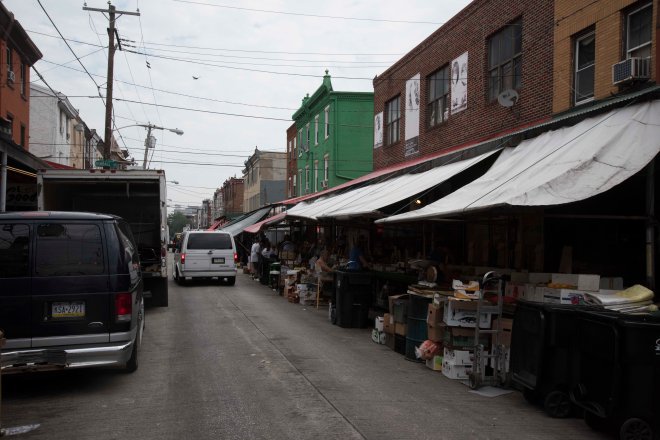
marketThe open-air Italian Market of South 9th street.
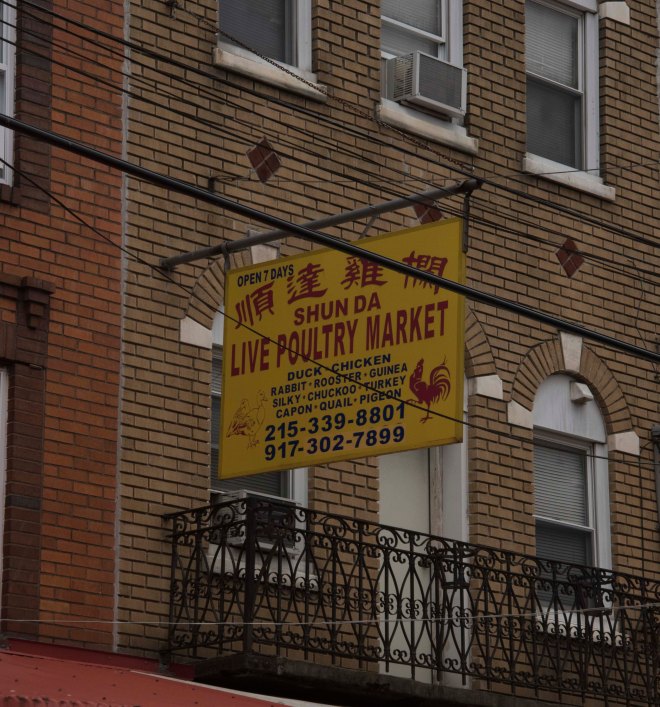
poultryIf you want really fresh chicken.

I really like Philly, but it isn’t perfect. Being founded in 1682, the downtown streets are not designed for cars. Parking is close to impossible. And like many metropolitan areas, there are homeless people trying to hang on by panhandling. Philly can be a great place to live, if you are young without children or retired. Not so sure I would want to raise kids there though.