We spent the past week in Oregon, for a wedding of my niece Katie. Who took her first steps in my cabin down in Indiana. About 25 years ago. And I got to play with my youngest niece, another Katie. Fun stuff.
 My niece Katie. I used to have hair that color. Now I’m happy to have any hair.
We liked Oregon. There’s some big open country there, with views you will never see east of the Mississippi. Lots of opportunities to play with the camera.
 Typical views. We’re not in Kansas anymore Toto.
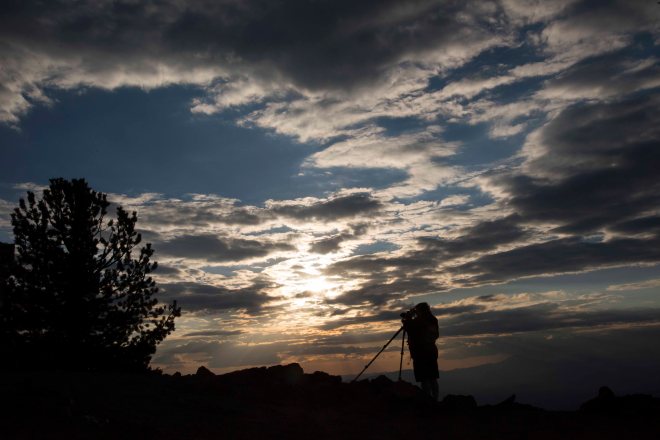 My sister Anita taking sunset pictures on Paulina Peak.
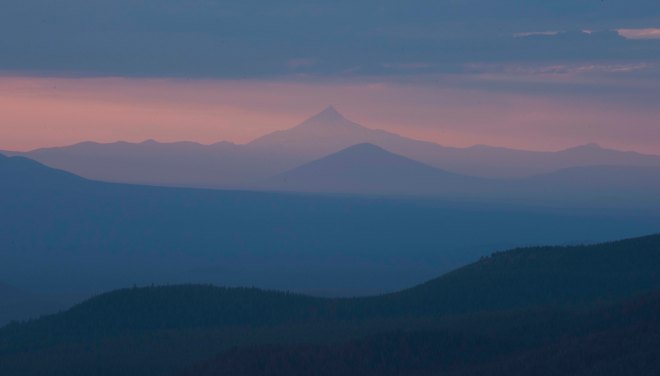 Sunset from Paulina Peak in color.
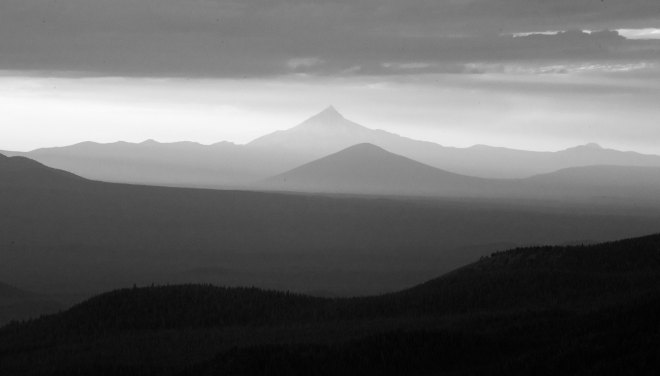 Sunset from Paulina Peak in shades of gray.
 Misty morning outside our cabin.
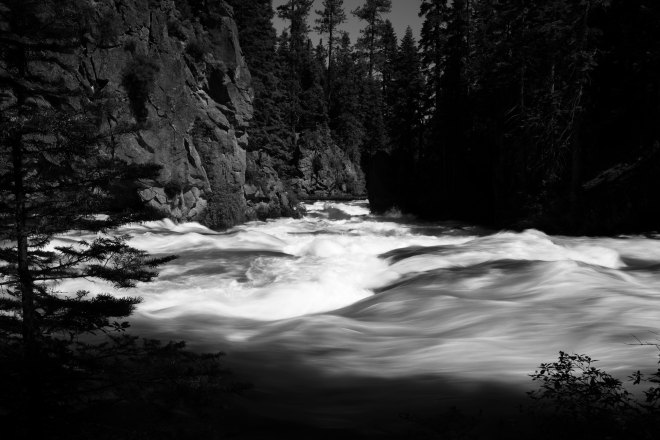 Benham Falls
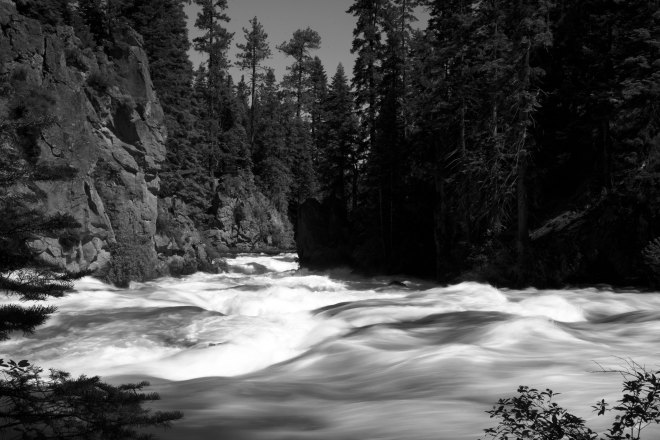 A slightly different view of Benham Falls.
We were a bit south of Bend, Oregon, on the dry side of the Cascade Mountains. When most people think of Oregon or Washington State, images of wet rain forests with huge moss-covered trees pop up. In reality, most of the state is on the dry side of the Cascade Mountains. And I do mean dry, as in sagebrush, tumbleweed, and desert dry. We went chasing burrowing owls out in the desert around a volcanic feature called Fort Rock. This place was isolated, and was day use only, but had a host living in a camper. Interesting retirement gig if you hate being near people. Just you and the coyotes. We didn’t get the burrowing owls, but we did get some good species like Swainson’s hawk, ferruginous hawk, golden eagle, black-billed magpie, sage thrasher, sage sparrow, Western meadowlark, and Brewer’s sparrow. Not species we’re going to find in Okemos.
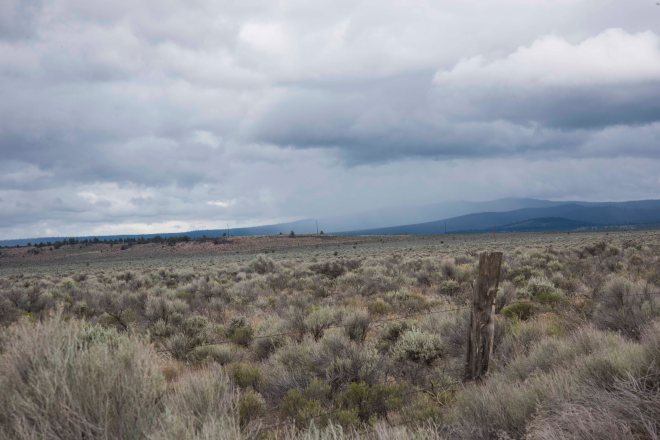 The open desert, about an hour east of where we stayed.
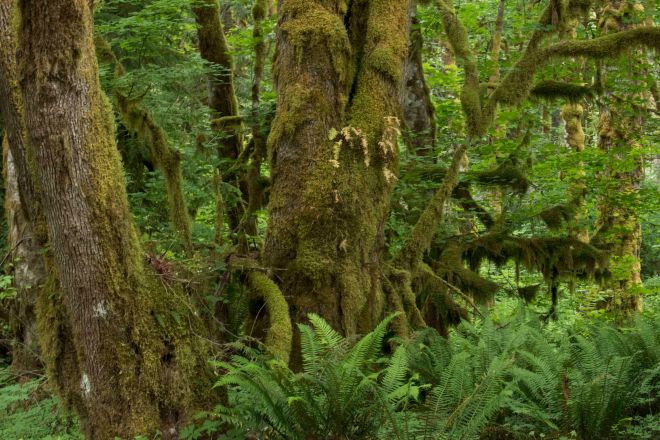 For contrast, a quick rain forest shot, about two hours west of where we stayed.
The whole place isn’t desert though. We were in the land of the ponderosa pine. Some serious big trees. Most of the area where we were had been heavily timbered in the past. I don’t think we saw any significant virgin timber. There were a few pre-European trees around though, and some places with trees maybe a hundred years old. Enough to give you an idea what was once there before we turned it into plywood and paper towels.
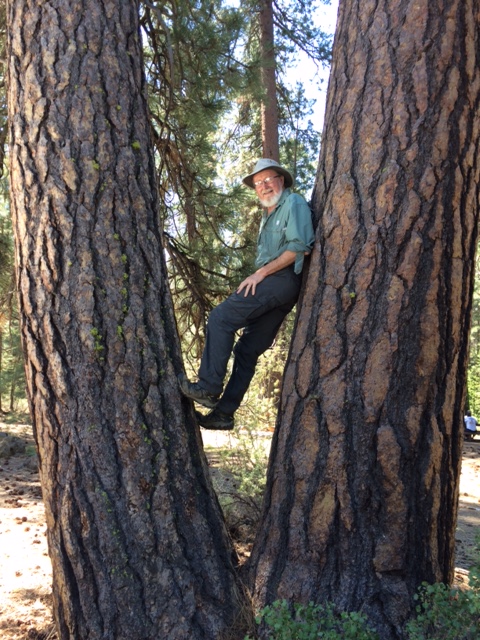
Big trees. (Lise photo)
If you are a volcano enthusiast, this is the place to go. We played around in the Newberry Caldera, which last erupted about 1300 years ago. It is still considered an active volcano and is monitored the U.S. Geological Survey as such. In the caldera we hiked the rim of one volcanic crater and walked on an obsidian flow.
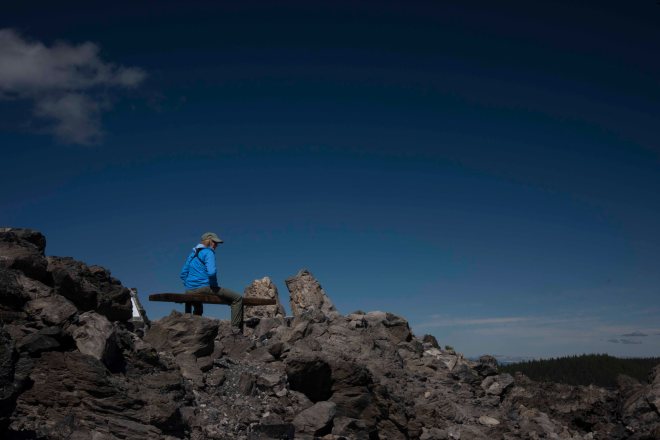 Lise on the obsidian flow.
 A lone tree growing through the obsidian.
A few miles north of the Newberry Caldera area is Lava Butte. There we were walking on lava flows 7,000 years old. You get to observe a process in ecology called primary succession. This is a situation where vegetation is wiped away, but there is no soil. Only bare rock. Secondary succession, by contrast, is where vegetation is wiped away by some process like a flood, but there is soil still in place.
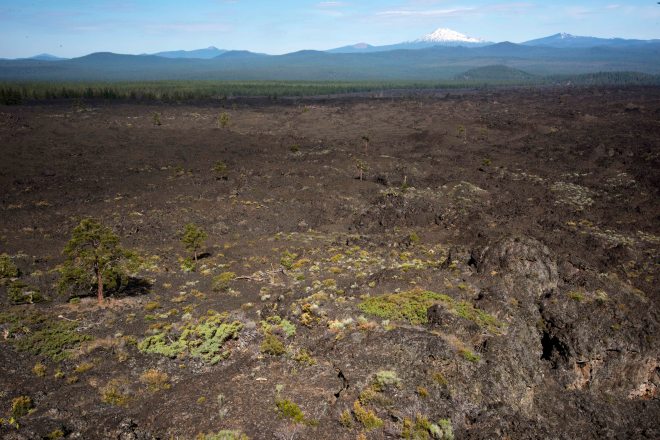 7,000 year old lava flow.
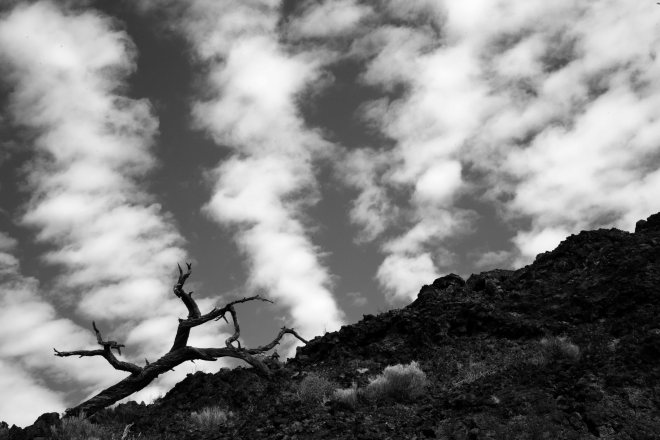 Lava flow and clouds.
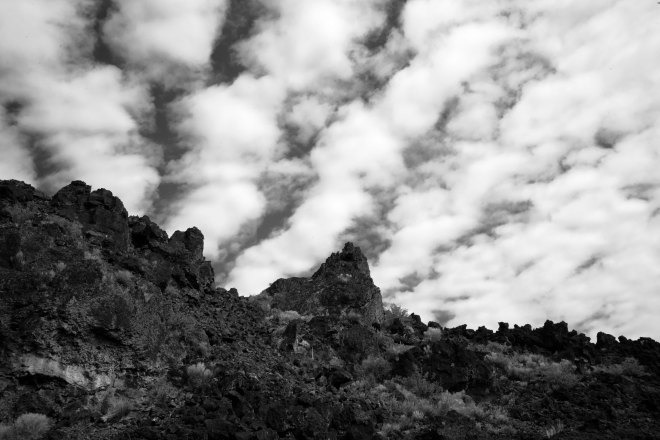 Lava flow and clouds.
When these volcanoes erupted, there was vegetation place. At the lava cast forest you can see tubes where the molten lava hit ponderosa pines 7,000 years ago. The water in the pines cooled the lava to form a tube, but the tree still burned away. After the eruption there was nothing but lava that cooled to stone. So now, a few thousand years later, these places are still mostly barren. There some lichens and small plants, but very few trees. The ponderosa pines and an interesting adaption for these conditions. Since soil and water is so rare, the tree has only one root that seeks water. The other roots only serve to anchor the tree. Then the tree grows in a spiral, so the water and nutrients are distributed to all sides of the tree.


Down in the cast of a 7,000 year old ponderosa pine. Where I’m probably not supposed to be.
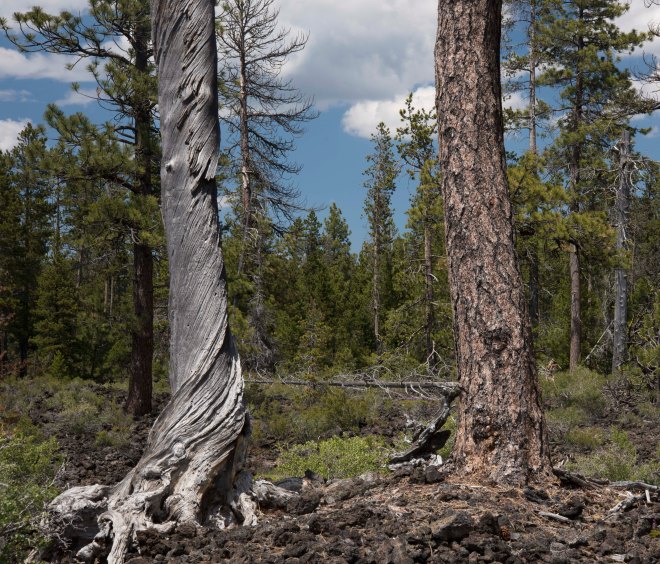 Twisted ponderosa pine.
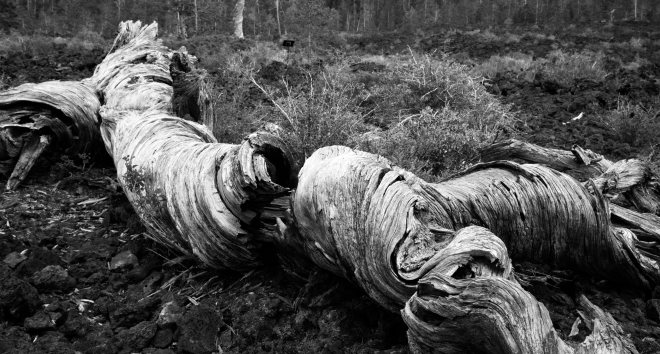 Twisted ponderosa pine.
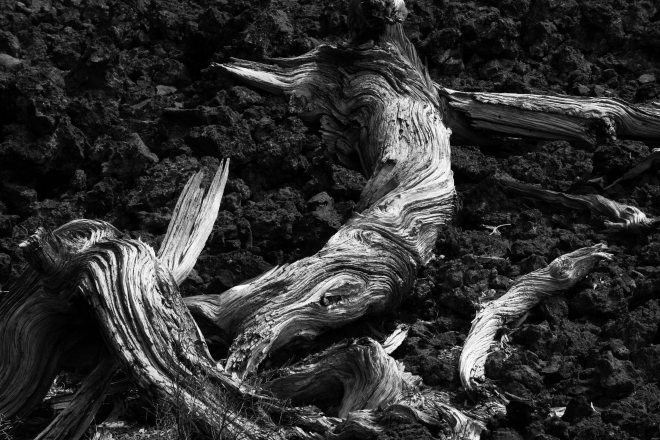 Twisted ponderosa pine.
One of the most impressive volcanic features was an underground, mile long, lava tube. The tube was longer, but only a mile was accessible. The tube was formed by lava forcing its way through an underground channel, melting the channel as it went. the outside of the lava cooled and hardened while the interior stayed liquid and flowed out. The tube we were in had some chamber roofs that were an easy 50 feet high, and the roof was 30 feet underground. This was a rather pleasant way to go caving. Walking upright in a dry channel. Only once or twice did you have to even bend over a bit. The tube had such a large volume it would take a biblical flood to fill it up.
 Looking back at the entrance dropping down to the tube.
 Lise in the tube. Maybe a half mile in.
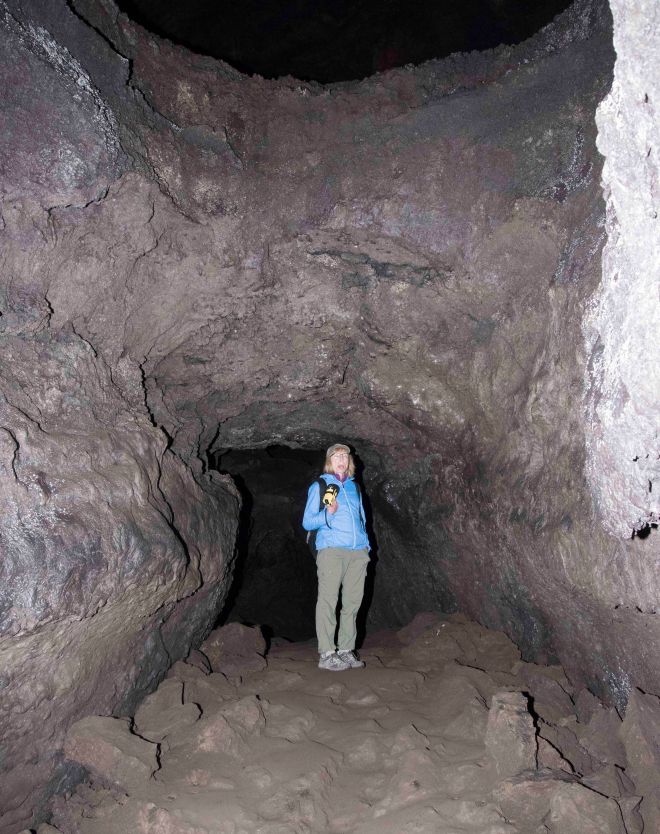 One tube on top of another.
 A nice little sign at the end of the accessible part.
We learned a new Scrabble word too. Kapuka – a Hawaiian term to describe an island of vegetation that was not obliterated by a lava flow. Goes great with other Hawaiian terms describing lava like pahoehoe and aa. Great terms to know when you have to get rid of a bunch of vowels.
Birding was good. Lise got 29 species for the year and I got 30. Lise is at 215 species for the year and I’m at 213.
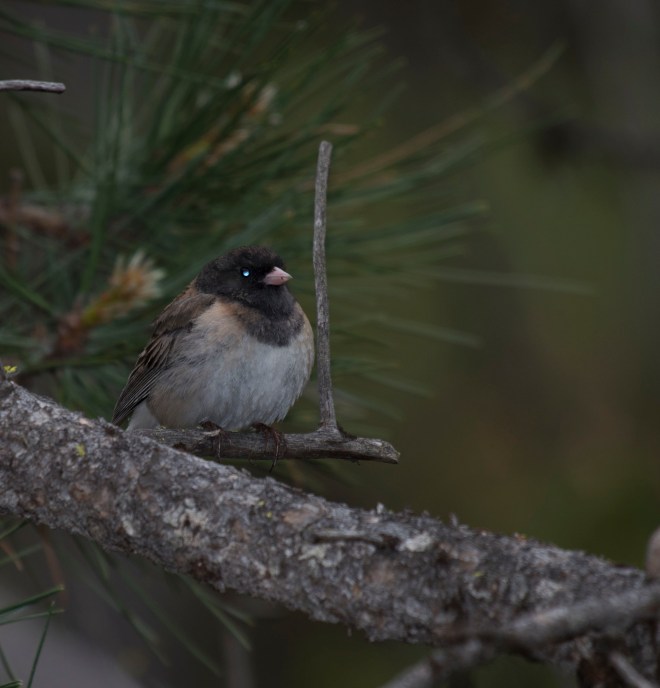 Oregon junco. Now grouped in with other juncos as the “dark-eyed junco” so it didn’t count as a new species.
Warning: Following is an anti air travel tirade. Nothing really intelligent so feel free to ignore.
I also think I may have taken my last domestic airline flight. Mostly because of the inane security process. I don’t mind security, but paranoia helps no one. We now have the technology to quickly detect the minutest traces of explosives. The need to make everyone take off their shoes, without giving them a place to sit down, is ludicrous. Or that you can’t take a bottle of water or cup of coffee through security. When all it takes is a quick scan with existing technology to determine if that bottle of water is in fact a deadly explosive. What is really galling is that you can pay for a status that will get you through with minimal checks. Or if you are older than 75 or have disabilities you can get through quicker. So, if I’m a jihadist terrorist, I either pay a few bucks to get an enhanced status or recruit someone with a profile that gets a bye through security. It’s not like the security is particularly effective either. For all the indignities of removing your shoes and belts to find potential weapons, my sister-in-law got through security with an undetected pair of scissors. I once made it through with a straight razor.
Then add to the mix that the airlines try to milk every last cent out of you. At one time you could check two bags for free. Now there’s a fee for checking any bags. You are crammed into packed airplanes like sardines. Where they used to serve a small meal or snack, now they will sell you something to eat. I used to love flying. Now, it just isn’t fun anymore. I’m tired of the stupidity of the American aviation system. It might be time to start driving everywhere. It takes longer, but I can carry everything I want, and I don’t have to empty my pockets to go through a scanner. We’re flying to Ireland soon, but we are going to fly out of Toronto. Hopefully they’re a bit more intelligent about everything.
 Ed's and Lise's Biggish Years